
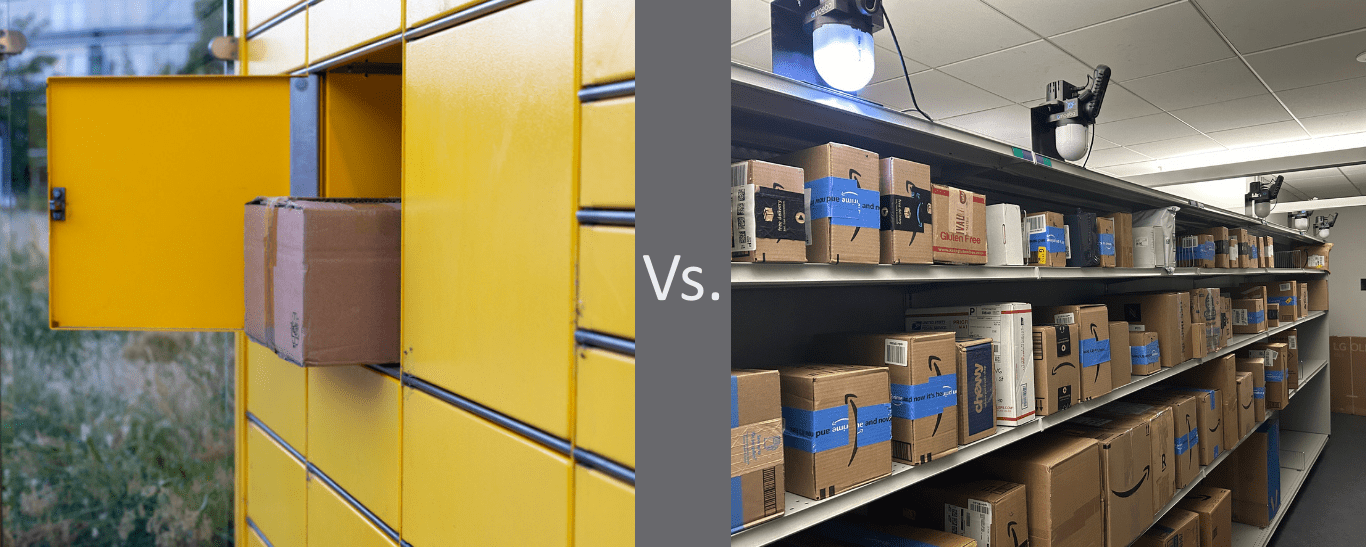

The right package delivery system is no longer a “nice to have” amenity but an essential operational decision. The e-commerce market is projected to reach over $7.9 trillion by 2027, and residents expect management to efficiently handle a constant influx of parcels of every size, shape, and type. When evaluating a multifamily package delivery solution, the choice for property managers usually comes down to smart package lockers or the Smart Package Room.
Both categories sit under the broader “smart package” umbrella but take different design philosophies. For smaller buildings or those preferring a lighter footprint, Smart Package Room Lite is the compact version of the platform, sized for properties where the full system would be more capacity than needed.
Lockers compartmentalize. Package rooms use open shelving with computer vision and access control. The choice has real consequences for resident satisfaction, staff workload, and renewal economics.
Smart package lockers were once seen as a breakthrough solution but now reveal clear limitations in a high-volume, high-variety delivery landscape. The Smart Package Room system’s open-shelf design, AI-powered tracking, and all-in-one package acceptance model deliver a more scalable answer.
In this article, explore the difference between smart package lockers and the Smart Package Room system, focusing on how each handles package acceptance, footprint, cost ROI, and resident experience. The goal is to help property managers, developers, and asset owners make a clear-eyed comparison instead of buying on brochure language.

Limitations of Package Lockers for Apartments
When smart package lockers first entered the market, they solved an obvious problem: a designated, secure drop-off point for deliveries. But as resident buying habits shifted, the case for moving beyond them has only grown stronger.
Fixed Compartments, Limited Acceptance
Smart package lockers operate with fixed-size compartments (i.e., small, medium, and large). While this seems versatile in theory, it results in inefficient use of space in practice. A small Amazon box can take up an entire medium compartment built to hold three or four packages of the same size. These constraints are exactly why package lockers fail in large apartment buildings.
As a result:
- Lockers fill up quickly, especially during peak delivery periods.
- Couriers leave larger or overflow packages in unsecured areas such as lobbies or on the floor near the lockers.
- Residents experience delays, confusion, or package theft when overflow sits exposed.
No Flexibility for Irregular Deliveries
Lockers also fall short with irregular package types. They lack dedicated areas for:
- Perishable items such as groceries or meal kits that require refrigeration
- Dry cleaning items, which can’t be stored in a metal box
- Bulky deliveries such as furniture or workout equipment
These shortcomings make smart package lockers a partial solution at best, not the complete parcel delivery system that today’s residents and property managers actually need.
Maintenance and Mechanical Failures
Locker compartments are mechanical. Doors, latches, and motors wear out, and every failed compartment is out of service until a technician arrives. Multiply that across a 200-unit building during peak season and the operational drag adds up.
Smart Package Room System: Designed for 100% Package Acceptance
While lockers rely on compartmentalization, the Smart Package Room system is built on open, adaptable shelving and dedicated parcel zones. This approach securely accommodates every package, regardless of size, type, or shape.
Open Shelving for Maximum Efficiency
Instead of locking deliveries into rigid compartments, the Smart Package Room solution uses open shelving to store standard packages efficiently. Envelopes and smaller parcels go into designated bins, while an oversized area accommodates large deliveries such as flat-screen TVs, mattresses, or sports equipment.
This design fits two to three times as many packages as traditional lockers into the same amount of floor space. Every inch of space is used strategically, solving the inefficiencies inherent in locker systems.
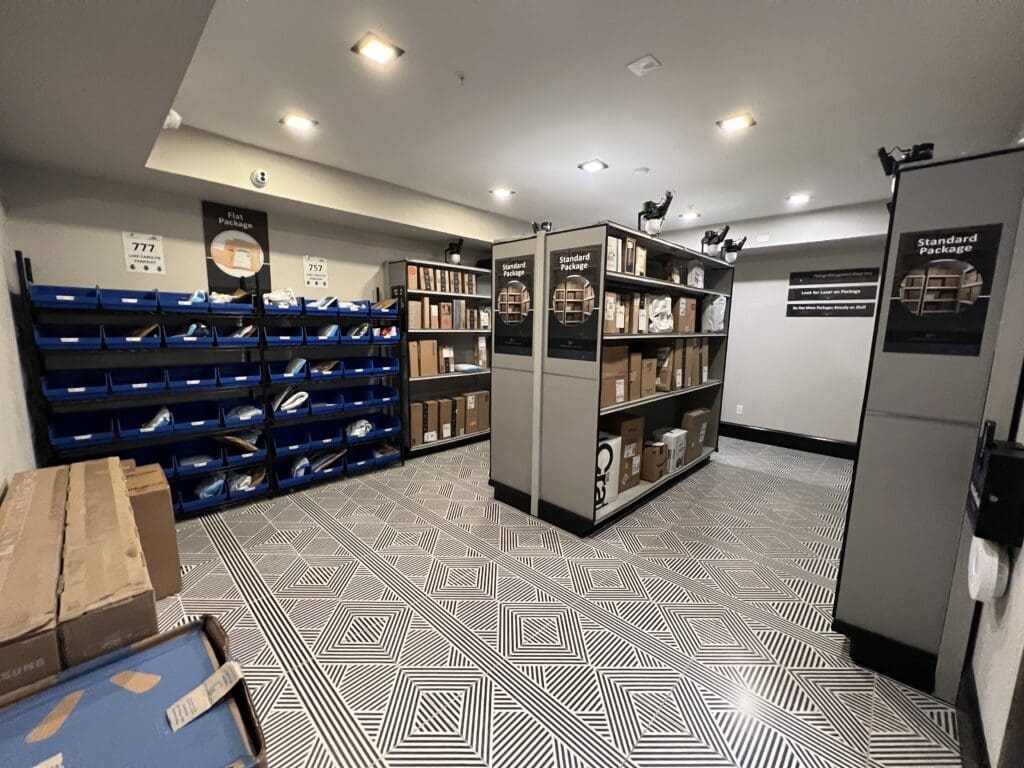
Specialized Areas for Irregular Deliveries
Unlike smart package lockers, the Smart Package Room platform offers dedicated areas for specialized items:
- Refrigerated area for perishable groceries and meal kit deliveries
- Dry cleaning area for clothing and laundry services
- Oversized area for heavy or irregularly shaped packages such as tires or furniture
Couriers and staff never need to “make do” with unsecured spaces, and residents always know their packages are stored correctly, safely, and conveniently.
Smart Package Room Lite for Tight Spaces
Not every building has the square footage for a full Smart Package Room. The Smart Package Room Lite is the compact alternative, sized for smaller properties, renovation phases, or operators who want to test the platform before scaling.
The hero Smart Package Room system uses computer vision tracking via the Amoeba Module for full chain-of-custody documentation on every parcel. The Smart Package Room Lite trades that depth of tracking for a smaller footprint, which fits boutique buildings and early-stage rollouts that don’t require the full tracking suite.
Streamlined Courier Delivery: One Location, Zero Confusion
For couriers, smart package lockers present another challenge. Once compartments are full, they have to place deliveries in alternate spots such as lobbies or storage closets. This not only complicates drop-off but creates a frustrating experience for residents, who hunt across multiple areas or contact the front desk to find their package.
By contrast, the Smart Package Room system centralizes all deliveries in a single, secure location. Couriers and staff drop packages on shelves or in zones based on type (i.e., standard, flat, oversized, refrigerated, or dry cleaning), and the system automatically logs and organizes each delivery.
The result:
- Faster deliveries for couriers, saving time on every trip
- Guaranteed acceptance of every package, no matter how full the room gets
- Zero misplaced packages, since everything is tracked in one controlled environment
Resident Experience: Precision Tracking and Secure Access
Smart package lockers often deliver mixed results for residents. While notifications alert them to a delivery, they may arrive to find the locker bay is full, their package left unsecured, or worse, that it’s been stolen. Even when a locker is available, residents have to hunt through a wall of compartments hoping their code works.
The Smart Package Room platform transforms this process into a smooth, tech-enabled experience. Access-controlled entry ensures only residents, couriers, and authorized staff can enter the room.
AI-powered precision tracking from the Amoeba Module visually monitors each package on the standard shelf, and presence sensors monitor personnel in the room 24/7 to deter theft. Light, laser, and audio guidance direct residents to their exact package location in seconds.
This reduces frustration and lifts security. Residents get the confidence of knowing deliveries are always safe and accessible. The system’s time-stamped delivery logs establish a verifiable chain of custody by documenting every package’s location from the time it is delivered into the room.
Cost ROI and Footprint: The Numbers That Matter
Property managers evaluating electronic parcel lockers vs staffed package rooms cost ROI usually look at three buckets: upfront capital, ongoing operations, and resident impact. Here’s how the comparison shakes out.
- Upfront capital. Locker banks carry high hardware costs that scale with compartment count. The Smart Package Room system reuses existing space, replacing fixed compartments with shelving and sensors. Conversion of an existing mailroom is typically faster and cheaper than installing a new locker bank.
- Footprint efficiency. The Smart Package Room system stores two to three times more parcels per linear square foot than lockers because shelving flexes to actual parcel sizes. That’s lower square-footage cost per package handled and more room for amenity space elsewhere.
- Operations. Lockers create recurring expenses from compartment maintenance, lockouts, and lockouts forcing manual handling. The Smart Package Room solution uses software updates instead of mechanical service, and intake stays automated even during peak surges.
- Resident retention. Properties that adopt modern smart-package systems reclaim 25 to 30 hours of staff time per week that previously went to package handling, hours that shift back to leasing, renewals, and resident engagement. Both lockers and the Smart Package Room system contribute to those gains, with the right fit depending on building size and delivery volume.
Operational Benefits for Multifamily Property Managers
From a property management perspective, smart package lockers create operational drag:
- Staff intervene when lockers are full or compartments malfunction.
- Overflow packages require manual handling in alternate spaces.
- Locker maintenance and repairs create recurring expenses and out-of-service delays.
The Smart Package Room system eliminates these headaches by delivering:
- High-capacity storage in less square footage
- Automated logging and tracking that reduces staff involvement
- Scalability through shelf additions, overflow rooms, or layout reconfigurations sized to the community.
This makes the Smart Package Room system not just a package locker alternative but a future-proof investment in package management for multifamily housing.
Package Lockers vs. the Smart Package Room System: Direct Comparison
| Dimension | Smart Package Lockers | Smart Package Room System |
| Package acceptance | Limited by compartment size; cannot accommodate every delivery | 100% acceptance across standard, flat, oversized, refrigerated, and dry cleaning items |
| Space utilization | Inefficient; one small item can occupy a large compartment | Maximized; open shelving adapts to actual parcel size |
| Capacity per square foot | Baseline | 2x to 3x lockers in the same floor space |
| Irregular deliveries | No options for perishable or dry cleaning; limited oversized | Dedicated areas for perishable, dry cleaning, and oversized |
| Courier experience | Multiple drop-off points required when full | All-in-one location for every delivery |
| Resident pickup | Searching through lockers; overflow confusion | Light, laser, and audio guidance to exact package location in seconds |
| Security | Packages can sit unsecured in lobbies when full | Access control plus 24/7 in-room presence sensors and chain-of-custody logs |
| Scalability | Fixed compartments; difficult to expand | Flexible shelving and customizable layouts |
| Maintenance | Mechanical doors, motors, latches | Software updates only |
| Smaller footprints | Hard to size down | Smart Package Room Lite available |
The Future of Apartment Package Rooms
As ecommerce volumes continue to grow, multifamily properties that rely only on smart package lockers risk falling behind resident expectations. The Smart Package Room solution is not just a package locker alternative; it’s the next step for secure package delivery in apartments.
With total package acceptance, optimized space usage, AI-powered precision tracking, and the Smart Package Room Lite option for smaller properties, the system meets modern volume across building types.
For property managers, this results in fewer headaches, reduced staff intervention, and a premium amenity that lifts resident satisfaction and retention. For residents, it provides peace of mind and a faster, frictionless pickup experience every time.
Frequently Asked Questions
What Is the Difference Between Smart Package Lockers and the Smart Package Room System?
Smart package lockers store parcels in fixed individual compartments. Residents receive an access code or app notification to retrieve their delivery. The Smart Package Room system replaces those compartments with open shelving, computer vision tracking, and zoned areas for every parcel type. The key practical difference is acceptance: lockers can refuse delivery when full, while the Smart Package Room solution accepts every package every time.
How Does the Smart Package Room System Compare to Smart Package Lockers on Capacity?
In the same floor space, open-shelf systems hold two to three times the packages of traditional lockers because shelving adapts to actual parcel sizes. A locker bank built for 100 packages can hold roughly 200 to 300 packages in the same floor space once converted to open shelving. That capacity advantage compounds during peak periods such as Cyber Monday and the holiday season.
Can Smart Package Lockers Handle Oversized or Refrigerated Deliveries?
Most smart package lockers cannot. Oversized items such as flat-screens or mattresses get pushed back to staff. Perishables such as grocery deliveries and meal kits need cold storage that locker banks don’t typically provide. The Smart Package Room system handles all of these in dedicated zones (e.g., oversized area, refrigerated area, dry cleaning items zone) without requiring a separate solution.
What Is the Smart Package Room Lite, and When Should I Choose It?
The Lite product is the compact form factor of the larger system. It’s built for smaller buildings or operators who want to pilot the technology before scaling. Lite preserves the same automation, access control, and chain-of-custody logging in a smaller floor space, which makes it a fit for boutique multifamily properties, renovation phases, or pilot deployments.
How Does the Smart Package Room System Handle Peak Delivery Surges?
Peak season is the moment most package systems break. The Smart Package Room solution absorbs surges through open shelving that scales with shelf count instead of compartment count, zoned overflow areas for oversized and refrigerated parcels, and automated intake that does not slow down when volume doubles. Properties that switch to the system report stable pickup times through move-in and the November to December rush, when locker-based setups typically overflow into hallways.
How Do Smart Package Lockers and the Smart Package Room System Compare on Cost ROI?
Locker banks carry higher upfront hardware costs that scale with compartment count, plus ongoing mechanical maintenance for doors and motors. The Smart Package Room system typically reuses existing space and replaces mechanical components with sensors and software, lowering both install and operating costs. Most properties recoup the investment within months from staff time savings, fewer disputes, and stronger renewals.
Do Smart Package Lockers Reduce Package Theft?
They reduce theft compared to open mailrooms because every delivery is locked in an individual compartment. But when locker banks fill up, couriers leave overflow in lobbies or by the entrance, and those packages are vulnerable again. The open-shelf alternative avoids this gap by accepting every package into the secured space, with presence sensors monitoring the room 24/7 and time-stamped logs documenting every entry.
Which Carriers Work with Smart Package Lockers and the Smart Package Room?
Both systems are carrier-agnostic at the core. Amazon, UPS, FedEx, USPS, and last-mile partners all deliver into smart package lockers and into the Smart Package Room. The difference is workflow consistency: couriers and staff at properties with a Smart Package Room follow one drop-off process, while lockers often produce inconsistent behavior when compartments are full and couriers improvise.
How Long Does It Take to Install a Smart Package Room?
When the room is already built, installation typically takes one to three days. Plan an additional two to four weeks for staff training, resident communication, carrier onboarding, and policy rollout. The Smart Package Room Lite deployments are typically faster because there is less technology to set up and test.
Can I Combine Smart Package Lockers with the Smart Package Room System?
Yes, hybrid configurations are common at properties with high or seasonal package volume. Some properties choose Amazon lockers for Amazon deliveries, for example, while all other carriers deliver into the Smart Package Room system. The hybrid approach maximizes capacity and gives residents flexibility, though most properties find the Smart Package Room system alone meets their needs without the locker bank.
How Does the Smart Package Room System Improve Resident Experience?
Residents enter the room with a QR code, follow light, laser, and audio guidance to the exact shelf location, and pick up packages in seconds. There’s no app to download, no compartment hunting, and no waiting on staff. Couriers use key cards or PINs to deliver. The combined effect is a fast, frictionless pickup that residents come to expect from modern multifamily amenities.
Key Takeaways
Comparing the two options comes down to one practical question: does the property need 100% package acceptance, or is partial acceptance acceptable? Modern parcel volume and parcel diversity push the answer toward open-shelf, AI-tracked systems.
- Lockers solved a real problem when first introduced, but fixed compartments now limit capacity, force overflow into unsecured spaces, and create recurring maintenance overhead.
- An open-shelf system delivers two to three times the capacity per square foot, handles every parcel type, and uses software updates instead of mechanical service.
- For smaller buildings or pilots, the Smart Package Room Lite delivers the same automation in less space.
- The cost ROI math favors the open-shelf approach when you account for footprint efficiency, lower maintenance, and the renewal lift from a premium package amenity.
The right choice for your property depends on volume, footprint, and resident expectations, but the trajectory is clear: open-shelf, AI-tracked package rooms are where modern multifamily is heading.
Make the Future-Ready Package Management Choice
Lockers solved yesterday’s problem; the Smart Package Room system solves today’s. If you’re ready to evaluate the right configuration for your property, book a demo, and a specialist will walk you through the design, footprint, and ROI for your building.