
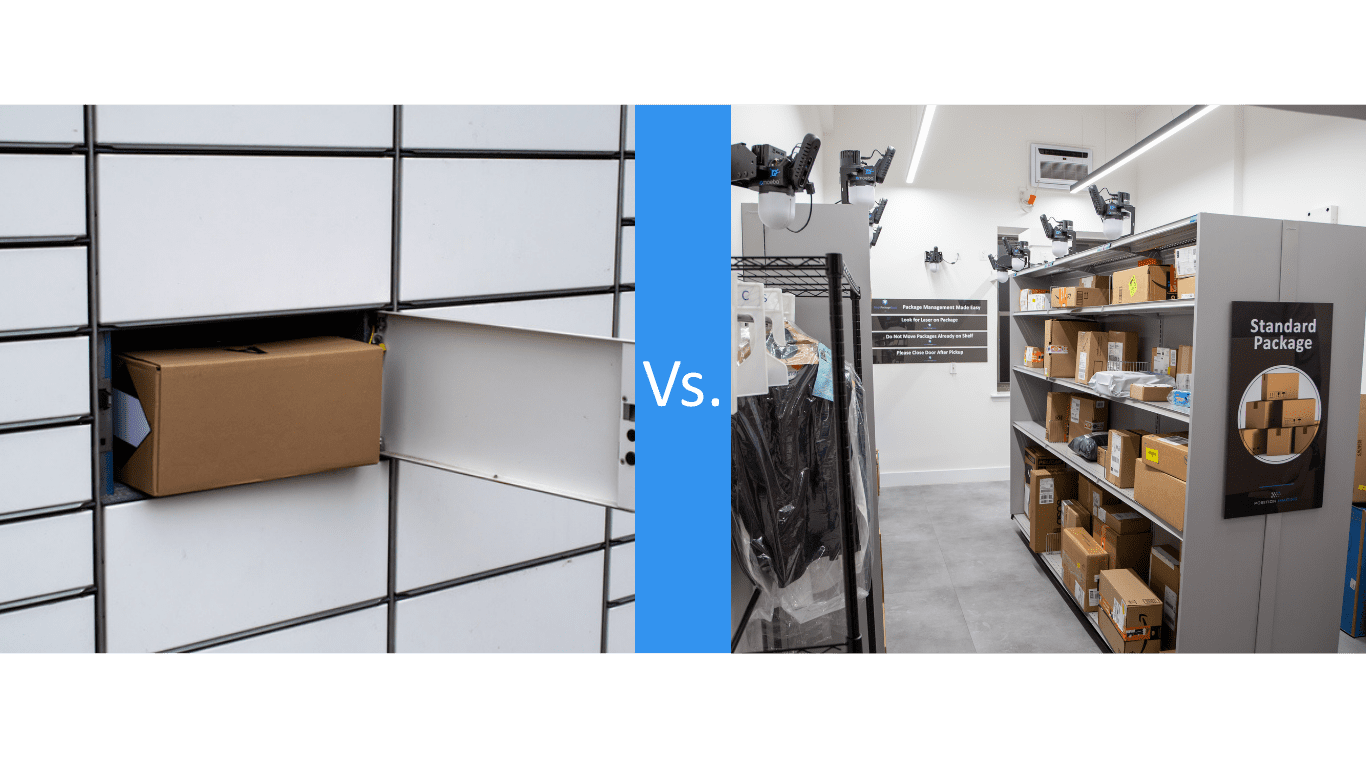

Package delivery is an ongoing challenge for apartment communities, and apartment package volumes keep rising year over year. In 202Choosing between parcel lockers and package rooms is one of the most important operational decisions multifamily property managers make in 2026. If your property is weighing multifamily parcel locker alternatives, this guide compares the two paths apartment buildings actually pick from today.
Apartment package rooms are dedicated secure spaces with shelving, access control, and tracking software, sized for diverse parcel types and high volume. Modern versions such as the Smart Package Room system from Position Imaging add computer vision and chain-of-custody logging.
Parcel lockers are modular banks of secure self-service compartments where couriers drop parcels and residents retrieve them with a code or app.
Both improve on a traditional mailroom but trade off differently across capacity, space, oversized handling, and cost. The right system reduces lost packages, frees staff time, and lifts renewal rates; the wrong one creates overflow, complaints, and avoidable cost.
Apartment package volumes keep rising year over year. Online sales in the U.S. reached $241.4 billion between November and December alone. In 2025, U.S. parcel volume grew to 23.1 billion, a 3.3% increase over 2024. These numbers underscore the strain on mailrooms and front-desk workflows.
What Are Parcel Lockers for Apartments?
Parcel lockers for apartments are modular banks of secure compartments installed in lobbies, mailrooms, or covered outdoor areas. Couriers select a compartment from a touchscreen kiosk and place the parcel inside. The system notifies the resident with an access code or mobile alert. Residents can then retrieve the parcel at any time.
To see how compartment systems stack up against open shelving on capacity, maintenance, and ROI, review this head-to-head multifamily comparison.
Apartment package lockers introduced automation and basic security to apartment deliveries, and they remain a solid fit for properties with steady, predictable delivery volume. The strengths are real: a clear chain of custody, a fast self-service pickup, and minimal staff intervention for parcels that fit the compartments.
Common Limitations of Parcel Lockers for Apartments
While parcel lockers were a meaningful upgrade from open mailrooms, they come with several drawbacks worth weighing before you sign a purchase order:
- Fixed compartment sizes. Oversized or irregular parcels (e.g., furniture, mattresses, sports equipment) don’t fit. A small envelope can occupy a medium compartment and waste capacity.
- Capacity bottlenecks. Once compartments fill, couriers leave overflow in lobbies or near the locker bank. Peak periods (e.g., Black Friday, Cyber Monday, holiday deliveries) make this worse.
- No flexibility for irregular deliveries. Perishables (e.g., grocery, meal kits) need refrigeration. Dry cleaning items don’t fit metal boxes. These get pushed to staff.
- High capital and maintenance cost. Each compartment has mechanical parts, electronic locks, and motors that wear out. Multiply that by 100 compartments, and the recurring maintenance adds up.
- Limited reconfiguration. Once installed, locker banks are difficult to relocate or expand. Older buildings with limited space may not be able to fit the system without major renovation.
Parcel lockers brought automation to apartment package management, but at the cost of space efficiency and adaptability. That has pushed many properties to evaluate apartment package rooms as an alternative.
What Are Apartment Package Rooms?
An apartment package room is a dedicated secure space with shelving, access control, and tracking software that handles every parcel type.
Instead of fixed compartments, packages sit on flexible open shelving. Couriers enter the room with a key card or PIN, place each parcel in the appropriate zone (e.g., standard, oversized, refrigerated, dry cleaning items), and the software automatically logs the delivery. Residents enter with a QR code or PIN and retrieve their parcels.
The modern apartment package room concept emerged as locker limitations became impossible to ignore. Property managers, developers, and operators started openly calling locker systems inflexible and space-inefficient, especially in dense urban properties. Industry press noticed the shift, too, with one multifamily cover story feature framing package management as a recruiting and retention tool.
High-tech package rooms answered the gap. They combine the security of a locked room with intelligent tech: presence sensors that monitor personnel 24/7, computer vision that tracks each parcel on the standard shelf, light and laser guidance to direct residents, and chain-of-custody logs that document every entry.
The Smart Package Room system from Position Imaging is one well-known example in this category. It uses the proprietary Amoeba Module for precision tracking and delivers two to three times the package capacity per linear square foot of traditional lockers.
Other vendors (e.g., Luxer Room, Smiota Smart Package Rooms, HelloPackage) build on similar principles with different software stacks.
Common Strengths of Apartment Package Rooms
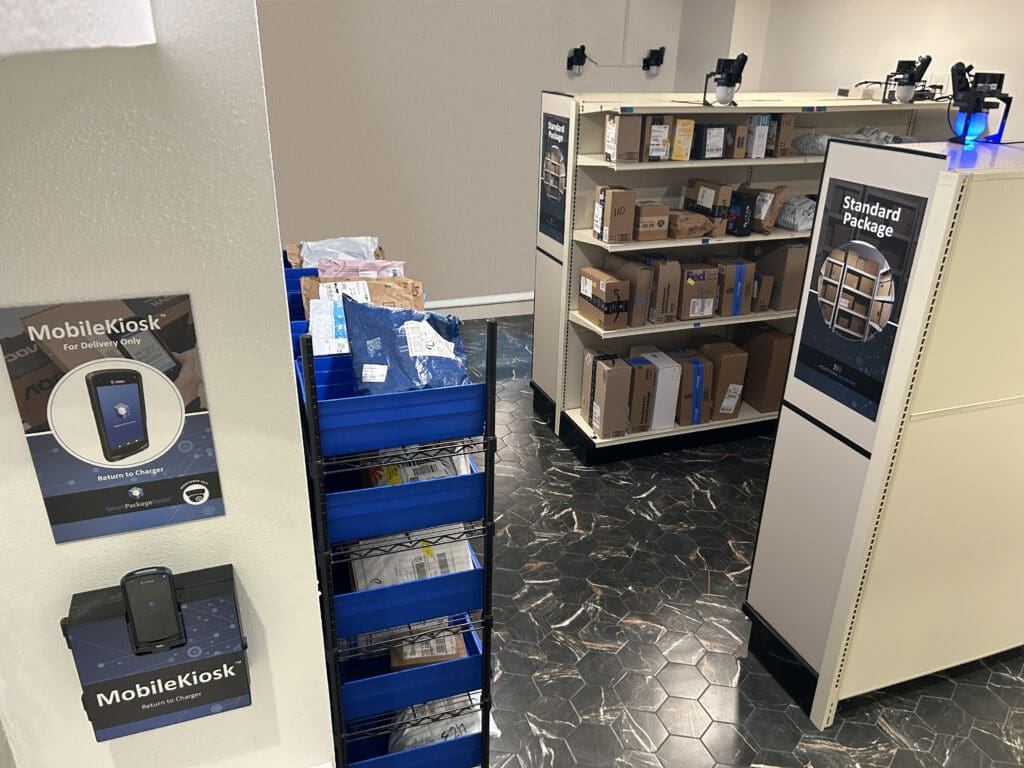
Apartment package rooms earn their place by solving problems compartment-based systems can’t. The strengths below explain why operators with high parcel volume often pick a room over a locker bank.
- 100% package acceptance. Open shelving accommodates every parcel size, from envelopes to mattresses.
- Dedicated zones for irregular items. Refrigerated zone for grocery and meal kits, dry cleaning items zone, oversized area for furniture and tires.
- Higher capacity per square foot. Shelves accommodate parcels of any size, delivering two to three times the capacity of locker banks in the same floor space.
- Lower maintenance. No mechanical compartments to fail. Software updates replace door and motor servicing.
- Retrofit-friendly. Existing mailrooms or storage areas can be converted with shelving and sensors.
The trade-off is that apartment package rooms require thoughtful layout planning and consistent organization to stay efficient. Without good signage, zone labels, and software, a package room can drift toward clutter.
Parcel Lockers vs. Package Rooms in Apartments: Direct Comparison
The table below puts the two systems side-by-side on the dimensions that matter most to operators.
| Dimension | Parcel Lockers for Apartments | Apartment Package Rooms |
| Package acceptance | Limited by compartment size; oversized and perishable items don’t fit | 100% acceptance across standard, oversized, refrigerated, dry cleaning items |
| Capacity per square foot | Baseline | 2 to 3x lockers in the same floor space |
| Footprint required | Fixed locker bank; full-wall installation | Existing room reused; flexible shelving |
| Irregular deliveries | No dedicated areas | Dedicated zones for refrigerated, dry cleaning, oversized |
| Courier experience | Multiple drop-off points when full | One location for every parcel |
| Resident pickup | Hunt through compartments with code | Light, laser, and audio guidance to exact shelf |
| Security | Compartment-level locks; vulnerable to overflow theft | Room-level access control plus 24/7 presence sensors and chain-of-custody logs |
| Scalability | Add new locker units (capital cost) | Add shelves or zones (low cost) |
| Maintenance | Mechanical doors, motors, latches | Software updates only |
| Best fit | Predictable volume, moderate footprint, standard parcel sizes | High volume, diverse parcel mix, space-constrained or flexible footprints |
| Capital cost | Higher per parcel handled | Lower per parcel handled |
Cost ROI: Parcel Lockers vs. Package Rooms in Apartments
Property managers comparing parcel lockers vs. package rooms typically weigh ROI across three buckets: upfront capital, operations, and resident impact.
Upfront Capital
Locker banks scale linearly with compartment count, and each compartment carries hardware cost. Apartment package rooms typically reuse existing space and replace fixed compartments with shelving and sensors, which drops the upfront investment significantly for buildings that already have a mailroom or storage area to convert.
Operations
Lockers create recurring expenses from mechanical maintenance, malfunctioning compartments, and lockouts that force manual handling.
Apartment package rooms use software updates instead of mechanical service. Day-to-day operations are typically lighter because residents self-serve, oversized items don’t overflow, and the chain-of-custody log resolves disputes in seconds instead of week-long investigations.
Resident Impact
Properties that adopt modern smart-package systems (lockers or package rooms) often see renewal rate lifts and reclaim up to 24 hours of staff time per week. Parcel lockers contribute similar benefits when they’re sized correctly, but properties that outgrow their locker bank often see those gains erode in 12 to 18 months.
The Best Parcel Lockers for Apartments (and When They Make More Sense)
Parcel lockers for apartments aren’t going away. They’re the right call in several specific scenarios:
- Predictable, moderate package volume. Properties seeing 30 to 60 packages per day with consistent parcel sizes get clean ROI from a properly sized locker bank.
- Limited interior space. If you don’t have a room to convert and outdoor placement is feasible, an outdoor locker bank can be installed in a covered area.
- Garden-style apartments. Smaller communities with simpler delivery flow often find lockers easier to manage long-term.
- Suburban or low-density properties. Lower parcel diversity and lower peak volume favor the locker model.
When evaluating the best parcel locker systems for mid-size multifamily buildings, the key criteria are: oversized-locker availability, carrier-agnostic access (Amazon, UPS, FedEx, USPS), integration with your access control system, durability of materials, and vendor support uptime.
When Apartment Package Rooms Win
There are also clear scenarios where apartment package rooms beat parcel lockers handily:
- High-density properties. Mid-rise and high-rise buildings with 200+ units and high daily volume need the capacity that locker banks can’t match.
- Diverse parcel mix. Properties where residents regularly receive grocery, meal kits, dry cleaning, or oversized items need the dedicated zones a package room provides.
- Peak-season flexibility. Buildings that handle volume surges during Cyber Monday, the holidays, or back-to-school benefit from a room that absorbs overflow without pushing parcels to staff.
- Older buildings with constrained mailrooms. Converting an existing space is usually cheaper than installing a full locker bank.
- Premium and Class A communities. Residents expecting a modern, frictionless amenity see open-shelf rooms as more upscale than a wall of metal compartments.
The Smart Package Room system is one apartment package room example that explicitly addresses the parcel diversity gap with its zone-based design (e.g., standard, flat, oversized, refrigerated, dry cleaning items).
Hybrid Approaches Are Increasingly Common
A growing number of properties don’t pick one or the other. They run a hybrid configuration where parcel lockers handle predictable standard parcels, and a smaller package room captures overflow, oversized items, and perishables. This combination maximizes capacity for buildings with high volume and diverse parcel mix, and it lets property managers buy each component to match its specific load.
The hybrid model is especially common in newer developments and student housing, where developers can plan the right mix of lockers and package room capacity from day one. For retrofits, hybrid usually means converting an existing storage area into a small package room while keeping the locker bank for routine parcels.
Frequently Asked Questions
What Is the Difference Between Parcel Lockers and Package Rooms in Apartments?
Parcel lockers for apartments store parcels in fixed individual compartments. Residents retrieve them with a code or mobile app. Apartment package rooms use open shelving in a secured space with access control and software tracking. The key practical difference is acceptance: lockers can refuse delivery when full or when parcels are oversized, while package rooms accept every parcel type. Capacity per square foot also differs significantly, with package rooms holding two to three times more parcels in the same floor space.
Which Is Better for High-Volume Apartment Buildings?
High-volume apartment buildings almost always favor a room-based approach. Locker banks have a hard capacity ceiling tied to compartment count, and once they fill, couriers leave overflow in lobbies. The room-based approach handles the same volume in less square footage and absorbs peak-season surges without sending parcels back to staff. That capacity headroom is why most 200+ unit buildings end up with rooms or hybrid configurations.
What Is the Best Parcel Locker System for Mid-Size Multifamily Buildings?
For mid-size multifamily buildings (typically 100 to 300 units with moderate parcel volume), the best parcel lockers for apartments share a few attributes: carrier-agnostic access for Amazon, UPS, FedEx, and USPS; oversized compartments for at least 10% of capacity; integration with your existing access control; durable construction rated for the climate (outdoor versus indoor); and a vendor with multifamily case studies and reliable support uptime.
Are Apartment Package Rooms More Secure Than Parcel Lockers?
Both approaches secure parcels behind locked entry, but they do so differently. Compartment-level locks are excellent for individual deliveries but vulnerable when overflow ends up in unsecured lobbies. Room-level access control, with presence sensors monitoring personnel 24/7 and chain-of-custody logs documenting every entry, holds up better during volume surges because every parcel stays inside the secured space.
How Much Do Parcel Lockers for Apartments Cost?
Parcel locker pricing varies by capacity, configuration, indoor vs. outdoor placement, and software features. Most multifamily installations land in the mid five-figure to low six-figure range for a 100-compartment bank plus software and integration, with ongoing maintenance and software fees. Apartment package rooms can be lower upfront when existing space is reused, and they typically deliver higher package capacity per dollar over a five-year horizon because there’s no mechanical service to fund.
Can Parcel Lockers Handle Oversized or Refrigerated Deliveries?
Most compartmentalized systems cannot. Oversized items such as mattresses, flat-screens, and furniture get pushed back to property staff. Perishables such as grocery and meal kit deliveries need refrigeration that locker banks don’t typically include. A room-based approach handles both in dedicated zones (e.g., oversized area, refrigerated area) without requiring a separate workaround.
Do Residents Need an App to Use Parcel Lockers or Apartment Package Rooms?
Most modern parcel lockers and apartment package rooms offer both options. Residents can use a mobile app for faster pickup, instant alerts, and a delivery history, or they can use a QR code or PIN at the touchscreen kiosk. The Smart Package Room system, for example, lets residents pick up packages without downloading an app, while couriers use key cards or PINs to deliver.
How Long Does It Take to Install Parcel Lockers or an Apartment Package Room?
Parcel locker installation typically takes one to two days plus one to two weeks of carrier and resident onboarding. Apartment package room conversion of an existing space usually takes one to three days plus two to four weeks for staff training, resident communication, and carrier onboarding. New construction is faster because power, network, and access control can be specified into the building plans from day one.
What’s the Hybrid Model for Apartment Package Management?
The hybrid model combines parcel lockers and a package room. Lockers handle standard, predictable parcels for fast self-service pickup, and the package room captures oversized items, perishables, and overflow. This is increasingly common in mid-rise and high-rise apartments where neither approach alone covers the full parcel mix. Hybrid configurations cost more upfront but deliver maximum flexibility for properties expecting steady volume growth.
How Do Parcel Lockers and Package Rooms Affect Resident Retention?
Residents now treat secure, fast package pickup as a top amenity priority. Properties that modernize their package delivery system see renewal lifts and stronger online reviews. The flip side is also true: chronic package complaints, lost parcels, and overflow drag down review scores and renewals. The combined effect across a tight leasing market can move occupancy by single digits, which is why most property managers treat the parcel locker vs. package room decision as core infrastructure.
Key Takeaways
The choice comes down to volume, parcel diversity, and footprint. Both options are real improvements over a traditional mailroom, but they hit their ceiling at different points.
- Parcel lockers for apartments work well at moderate, predictable volume with standard parcel sizes; they struggle when oversized items, perishables, or peak surges arrive.
- Room-based systems deliver two to three times the capacity per square foot and accept every parcel type, which makes them the stronger fit for high-volume properties and diverse parcel mixes.
- The cost ROI math favors rooms over a five-year horizon because of lower maintenance and higher capacity per dollar.
- Hybrid configurations (lockers for standard parcels plus a smaller room for overflow) are increasingly common in mid-rise and high-rise buildings.
The right answer for your property depends on volume, available space, parcel mix, and resident expectations, but the trend is clear: modern apartment buildings are shifting toward room-based or hybrid models for the operational headroom they provide.
Ready to Compare Parcel Lockers and Package Rooms for Your Property?
If you’re evaluating parcel lockers vs. apartment package rooms for your community, book a demo, and our Smart Package Room team will walk you through which configuration fits your building, the rollout timeline, and the cost ROI math for your specific volume and footprint.