
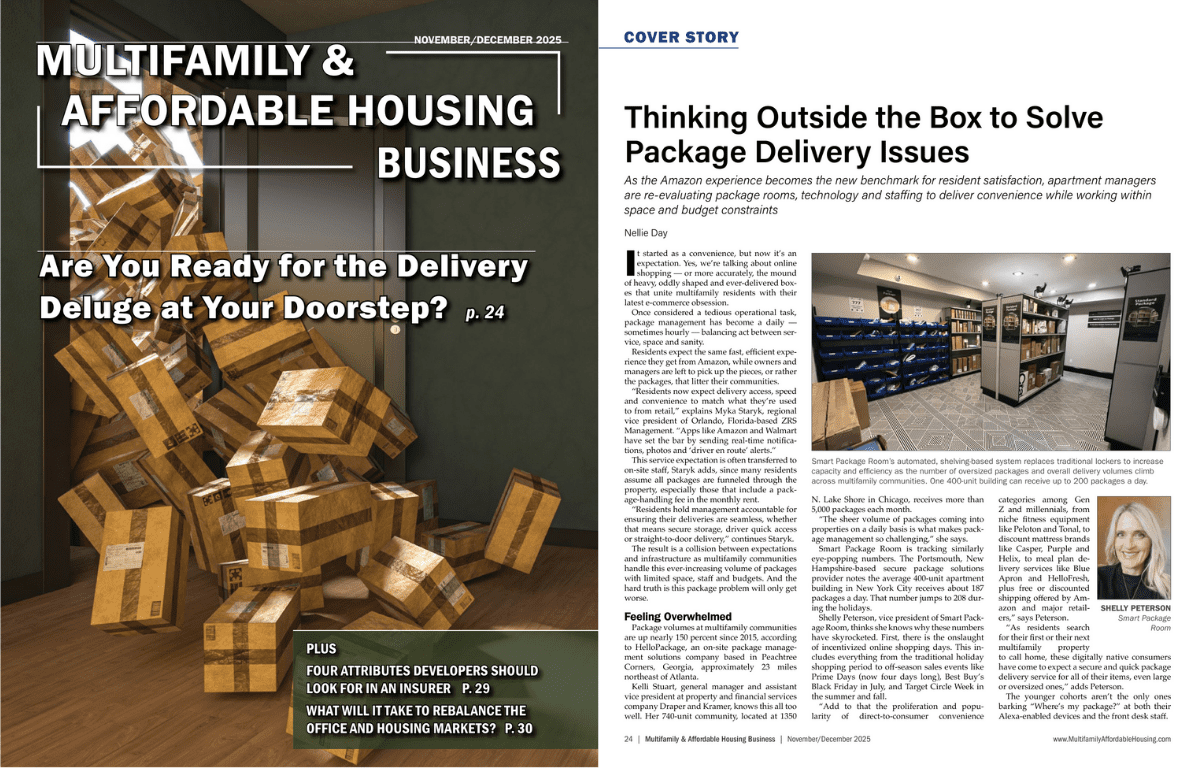

The trade publication Multifamily & Affordable Housing Business ended 2025 with a cover story on amenities that the Smart Package Room team knows quite a bit about.
Package Management. Two words that are in a symbiotic relationship with another pair of words: online shopping. As online shopping habits become a norm, having a reliable multifamily package delivery solution for properties and student housing has evolved from a luxury into a necessity.
In her cover story for the November/December 2025 issue of Multifamily & Affordable Housing Business, journalist Nellie Day asks the question, “Are You Ready for the Delivery Deluge at Your Doorstep?” To answer this question, she interviewed technology experts, industry leaders, developers and property managers to get a holistic understanding of challenges faced by all when packages are being delivered at unprecedented rates every day of the year.
Over the course of five pages, she peels back the layers of the issue to understand: how the increased package volumes are making property managers feel; how existing solutions such as package lockers are holding up; how developers are attacking the issue earlier in the process; and how new technologies are being leveraged to solve the problem.
Lockers are Falling Short
I was interviewed for this article and given the opportunity to speak to the categorical package management challenges that staff, operators and managers at multifamily properties and student housing are feeling with the package influx, and how our Smart Package Room® system is uniquely designed to handle it.
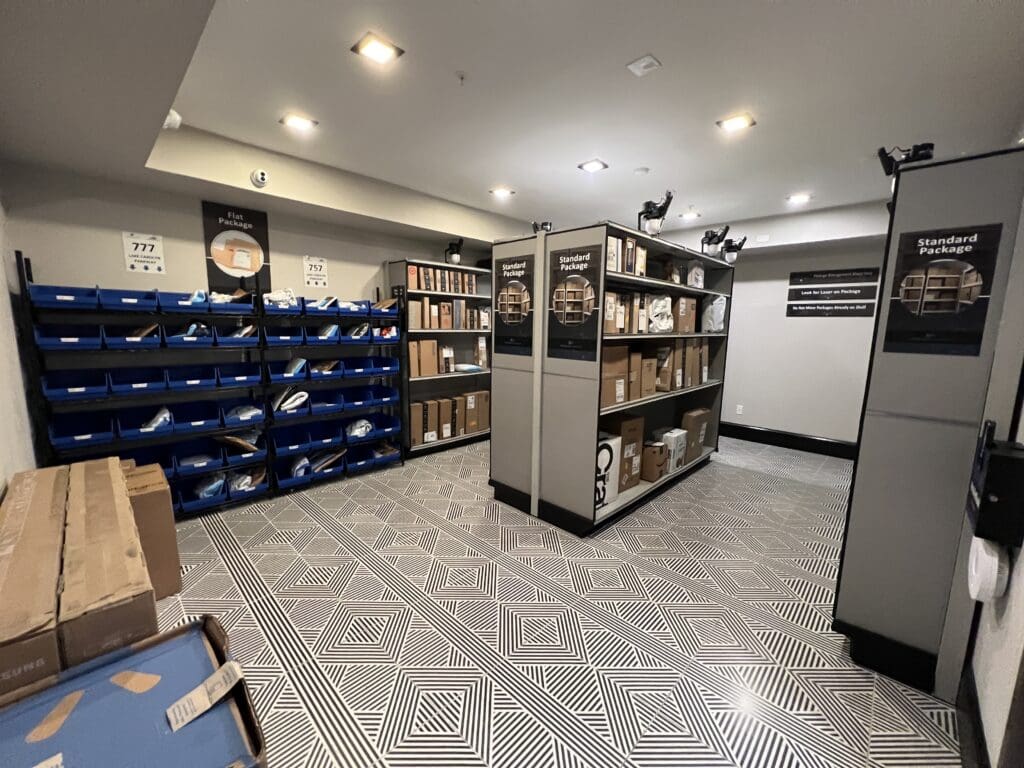
As I explained to the journalist, the Smart Package Room system features an open shelving design that allows for packages to be placed more efficiently, thus increasing the volume that a room can accommodate. In fact, the shelving layout allows properties to fit three times as many packages as traditional lockers in the same footprint. As package volumes have increased, lockers have fallen short in part due to their fixed compartment sizes, which result in inefficient use of space. Think of how much “empty space” is in a locker where a small Amazon envelope is placed.
On the other side of the spectrum, the increase in online shopping and popularity of direct-to-consumer brands—particularly among Gen Z and Millennials—has led to a proliferation of large and odd-shaped packages arriving at multifamily properties and student housing. Think mattresses like Casper, Purple and Helix, fitness equipment like Peloton and Tonal, and meal kit delivery services like Blue Apron and HelloFresh. These items will not fit into traditional locker bays, meaning they are placed outside of the lockers, unsecured, or given to front desk staff, who must find a place to store them, and are now in charge of resident outreach. At that point the digital custody chain is broken, leaving these expensive packages vulnerable to theft.
With the Smart Package Room solution, all packages (any shape, any size, any weight) are delivered into a secure package room with access-controlled entry. There are area-tracked zones for oversized packages, as well as refrigerators for meal kits, medicine and perishables. Access is restricted to couriers who use their assigned card or PIN number, staff who use their FOB or PIN number, and residents who are sent a package delivery notification and QR code via text or email.
I wasn’t the only person interviewed who spoke about the limitations of lockers in today’s climate of never-ending package deliveries. Lockers were widely described by the featured property managers, developers and tech advocates as inflexible, space-inefficient and unable to handle oversized deliveries.
Ermin Husic, the Community Manager at Habitat’s Cassidy on Canal, commented, “The number of packages—especially oversized deliveries like furniture—has exceeded what traditional locker systems can handle. Items such as headboards, nightstands, desks and sofas now arrive regularly and require significant space.”
Laura Khouri, President and COO of Western National Property Management, expressed a similar sentiment, “Parcel lockers were never designed for a sofa, so we’ve had to rethink space and logistics in ways that weren’t on our radar a few years ago, along with significant handling care.”
According to the article, lockers, which have been around for fifteen years and were once considered the cornerstone of any package management system, are now being phased out by some apartment complexes because of their high cost and inadaptability. Package management solutions that use space inefficiently and leave larger packages vulnerable to “porch pirates” (lobby pirates?) are at odds with the reality of the moment.
Package Management as a Recruiting and Retention Tool
Residents live in an on-demand world with access to goods of all shapes and sizes (and prices) at their fingertips. This level of convenience has affected how users shop at retail, as evidenced by the increasing adoption of self-checkout, BOPIS (buy online, pickup in-store) and using smartphones for in-store price comparisons and checking real-time inventory.
When it comes to online shopping, according to Myka Stark, Regional VP of ZRS Management, “residents now expect delivery access, speed and convenience to match what they’re used to at retail.” Properties that don’t keep up with or exceed these expectations will struggle to recruit new residents, particularly Gen Z and Millennials, and may be challenged to retain residents who have experienced package delivery delays or theft.
A Position Imaging/Harris Poll survey from 2024 validates the need for a secure package management solution at multifamily properties and student housing, and the potential cost to resident retention if they feel their deliveries are unsecured. According to the results, 60% of Americans were worried about porch piracy this past holiday season (2024). Despite that fear, nearly two thirds (65%) of Americans polled indicated that they planned to do most of their holiday shopping online. The kicker, 63% of Americans said they would be more likely to place online orders if a more secure delivery option was available.
Additional data in the article cites that, “eighty-five percent of renters say package convenience influences their leasing decisions”.
This aligns with the Smart Package Room team’s experience in the field. Many sites have informed us that one of the first amenities they show a prospective resident is the package room. I have personally seen individuals being led on a walk-through of a Smart Package Room solution with their smartphone capturing the tour for posterity. In those instances, I like to show prospective tenants how the system works. I take them through a resident pickup, showing them how easy it is to scan the QR code and follow the laser, light and audio cues directly to their package. It’s common for the leasing manager to give me a thumbs up as they continue with the apartment complex tour.
The Smart Package Room System in Action at Habitat’s Cassidy on Canal
Two properties currently experiencing success with the Smart Package Room system were featured in this cover story. Nellie (the journalist) reached out to Ermin Husic, the Community Manager at Habitat’s Cassidy on Canal, to get his first-hand account of the challenges that the property is facing, and how the Smart Package Room system stacks up.
Cassidy on Canal, a luxury high-rise apartment complex located in the heart of Chicago’s Fulton River District, uses two Smart Package Rooms to accommodate the daily package haul of their 343 units. The primary room is for standard sized packages and flat envelopes. All standard packages delivered to the property are placed on the Smart Package Room system’s open shelves, efficiently situated to maximize the delivery capacity. Once placed on the shelves, the Smart Package Room system’s Amoeba Module™ uses AI-powered computer vision technology to log the precise location of the package. Once the system registers the package, the resident is sent an automatic notification via text and email with a QR code for secure access into the room, and an image of the precise location of the package on the shelf. When the resident scans the QR code at the package room’s exterior kiosk, they are granted entry and directed to their package’s exact location on the shelf via laser, light and audio cues.

For flat packages such as padded envelopes and mailers, residents are directed to the flat package bins via audio guidance and a picture of the bins’ location on the kiosk map. The system records when any package is retrieved by its rightful owner, and the resident is sent a digital receipt. Pickup takes seconds, and thanks to the Smart Package Room system’s convenience, residents can plan to pick up their packages 24/7, on their own schedule.
The second package room at Cassity on Canal is reserved exclusively for oversized packages. There is ample room to securely safeguard the residents’ large and odd-shaped packages such as electronics, furniture and sports equipment. When the packages are checked into the room, the QR code notification that the residents receive indicates that their item is in “Package Room 2”, which holds all oversized packages.
This system (one room for standard packages, one room for oversized) works well for larger properties that receive an abundance of oversized packages daily. It also gives properties the capability to scale up, or flex, during the heavy shipping seasons such as Cyber Monday, Amazon Prime Days and other recurring eCommerce holidays (Fourth of July, President’s Day, and more). Regardless of which room a package ends up in, the resident is guaranteed to be texted or emailed a direct path to retrieve it.
When asked why he prefers the Smart Package Room system over traditional lockers, Ermin reiterates, “shelving instead of lockers.” With the ability to store more packages securely in a smaller footprint, his team can exceed their residents’ package delivery expectations. He even stated that switching to the Smart Package Room system resulted in the “biggest positive impact” on his residents.
He continued, “While lockers are convenient, they are space-inefficient since one small package can take up a large locker. By removing the constraints of locker sizes, we’ve significantly increased capacity and efficiency.”
Stuytown – America’s Largest Apartment Community
The second property to be featured in the article that trusts our Smart Package Room system with its package delivery needs is Stuyvesant Town in New York City. The nation’s largest apartment community is a long-time customer of the Smart Package Room solution. With more than 30,000 residents and 11,200 units, the daily package haul at Stuytown can top over one thousand packages on a busy day.
Before switching to the Smart Package Room system, they allocated twelve staff members or more at a time to manage the package deliveries. Residents became frustrated at wait times that exceeded half an hour to pick up their packages. Amidst the chaos and disorder, they turned to the Smart Package Room platform in an effort to streamline the flow of incoming packages, store them securely and in a more efficient manner, more quickly contact residents, and decrease wait times. The results were staggering.
Once the Smart Package Room system was installed, resident wait time plummeted 600%, to just seconds. The combination of automatic notifications, secure 24/7 pickup and laser, light, and audio guidance led to much faster package pickups and a notable increase in resident satisfaction. Keep in mind, for most residents, package pickup occurs on a weekly, if not daily, basis.

The impact on staff and salary was just as impressive. Stuytown was able to reduce the number of staff managing deliveries to just two employees. This has freed up additional staff (and budget) to focus on other value-added duties that improve the resident experience.
Futureproof Package Management
As we look further into 2026, our team is more excited than ever to introduce the Smart Package Room system to multifamily properties and student housing across the country. Industry and economic predictions for the year show no signs of a slowdown in online shopping, meaning that once again, there will be more packages out for delivery than ever before.
Residents and students will continue to order their favorite goods, large and small, for delivery to their home. Delivery vehicles will line the streets of our cities and suburbs, while couriers will enter apartment complexes at a staggering rate. This means that package management will continue to be on the minds of property developers and operators looking to make the most out of their limited, and valuable, square footage.
This is no doubt why package management was also on the minds of the editors and journalists at Multifamily & Affordable Housing Business. Their thorough reporting does a great job of detailing what we all feel—developers, operators, residents, and tech solutions providers. I was glad to be a participant in this story, and I hope that my insights—curated from years of experience in the field of package management—helped move the conversation forward to a future where package management feels more… manageable. Contact us today to learn more about our future-proof Smart Package Room system for multifamily and student housing.