

Package volume in U.S. residential buildings keeps rising every quarter, and the operations teams sitting under that volume feel it first. Couriers triple-stack the lobby, residents flood the leasing inbox with “where is my package” messages, and front-desk staff spend half their shift logging parcels instead of leasing units. For multifamily property operators, streamlining package delivery in residential buildings is the single operational fix that directly protects renewal rates, resident satisfaction, and Net Operating Income.
Most operators solve the package bottleneck by pairing a computer vision-tracked package room with a MobileKiosk that absorbs surge volume on Cyber Monday and move-in week. Properties that know how to streamline package delivery in residential buildings recover staff hours, reduce theft to near zero, and turn package handling into a renewal-driving amenity instead of a daily operational liability.
The numbers behind that pressure are clear. In 2024, U.S. parcel volume hit 22.4 billion shipments and is projected to reach 30 billion by 2030. The SafeWise 2025 Package Theft Report estimates 104 million packages were stolen in the U.S. last year, costing residents roughly $15 billion. Meanwhile, the Security.org 2025 Package Theft Report finds apartment and condo residents are more than three times as likely to lose a parcel as single-family homeowners.
In this guide, we walk you through the cost of a broken parcel workflow, the four common package delivery options for multi-unit residential buildings, the decision criteria that matter, and a seven-step rollout plan you can adapt to your portfolio.
Why Streamlined Package Delivery Has Become an Operational Priority for Residential Buildings
Package delivery is no longer an occasional courtesy task at the leasing desk. It is one of the highest-frequency resident touchpoints in your building, and the cumulative friction shows up in renewals and online reviews.
Most residents in locker-equipped buildings use the lockers weekly to retrieve at least one package. Lockers now outrank business centers, clubhouses, and pools when residents rank amenities they actually use
The operational side is just as important. NMHC’s mail and package delivery resource center describes parcel handling as a growing operational challenge for property managers as online shopping expands. On-site teams routinely lose meaningful hours each day to sorting, logging, and resident handoffs, time pulled directly from leasing, renewals, work orders, and tour conversion.
For a 250-unit building averaging four to six parcels per unit per week, you are not buying back hours by streamlining package delivery; you are buying back full-time equivalents. Resident expectations have also shifted. Younger renters compare your property’s package handling to the experience they get at work or at home. Knowing how to streamline package delivery in residential buildings is the signal that says this property runs like the brands its residents already trust.
The Real Cost of Broken Package Delivery in Multi-Unit Buildings
Before shopping for any package delivery system for apartments, put a dollar figure on what your current workflow already costs you. Most operators dramatically underestimate it because the loss is spread across line items that no single report ever ties together.
Start with Theft
The Security.org 2025 Package Theft Report puts the annual U.S. loss at roughly $8.2 billion. It also notes that people in apartments and condos are more than three times as likely to have a package stolen as those in single-family homes.
Every stolen parcel triggers a chain reaction: a resident complaint ticket, a staff investigation, a chargeback or refund dispute, sometimes a one-star online review, and almost always a hit to renewal probability.
Add Staff Hours
If a front-desk associate spends two minutes per parcel logging, notifying, and handing off, a 250-unit building handling 1,000 parcels a week loses 33 hours of capacity every week. At a fully loaded $25 per hour, that is roughly $43,000 in annual labor reallocated to package handling that should be funding tours and resident events.
Then there is the lobby footprint. Stacked packages compress your leasing first-impression area, push couriers into common spaces, and produce the cluttered look that erodes property positioning. Buildings without an organized package delivery system lose tour-to-application conversion for reasons no one tracks in the CRM.
Account for Resident Churn
Package handling problems consistently land in the top three operational complaints driving non-renewal. Multi-unit package delivery friction is rarely the only reason a resident leaves, but it is often the one they remember most clearly at lease end.
With theft, staff hours, lost conversion, and resident churn all stacking, the total cost of broken package delivery for a typical 250-unit building runs well into six figures. Run your specific building’s numbers through our package management cost calculator to see your exact exposure.
Common Package Delivery Options for Multi-Unit Residential Buildings, Compared
When you evaluate how to streamline package delivery in residential buildings, you generally land on four options. Each solves part of the problem and leaves a different gap, which is why the right answer is usually a combination rather than a single product.
1. Manual Front-Desk Handoff
This is the default at most legacy buildings. Couriers drop everything at the desk, staff logs it, and residents pick it up during office hours. It is familiar, but it does not scale. It puts your highest-paid front-desk hours on the lowest-value task in the building.
2. Drop Box Lockers
Smart lockers improved the workflow significantly when they launched a decade ago. Residents get a code, lockers stay secured, and staff stops touching every parcel. The best drop box lockers for multi-unit residential buildings work well for medium volume, but they struggle at peak season, with oversized items, and with grocery and meal kit deliveries.
ButterflyMX’s own product literature flags this directly: locker compartments are fixed, so they cannot fit very large or oddly shaped packages. Capacity cannot be adjusted without buying and installing more locker banks. When lockers fill, the building falls back to the manual workflow and starts paying for both systems at once.
3. Smart Package Rooms
These are dedicated rooms with open shelving, secured entry, and computer-vision modules that track every parcel from drop-off to pickup.
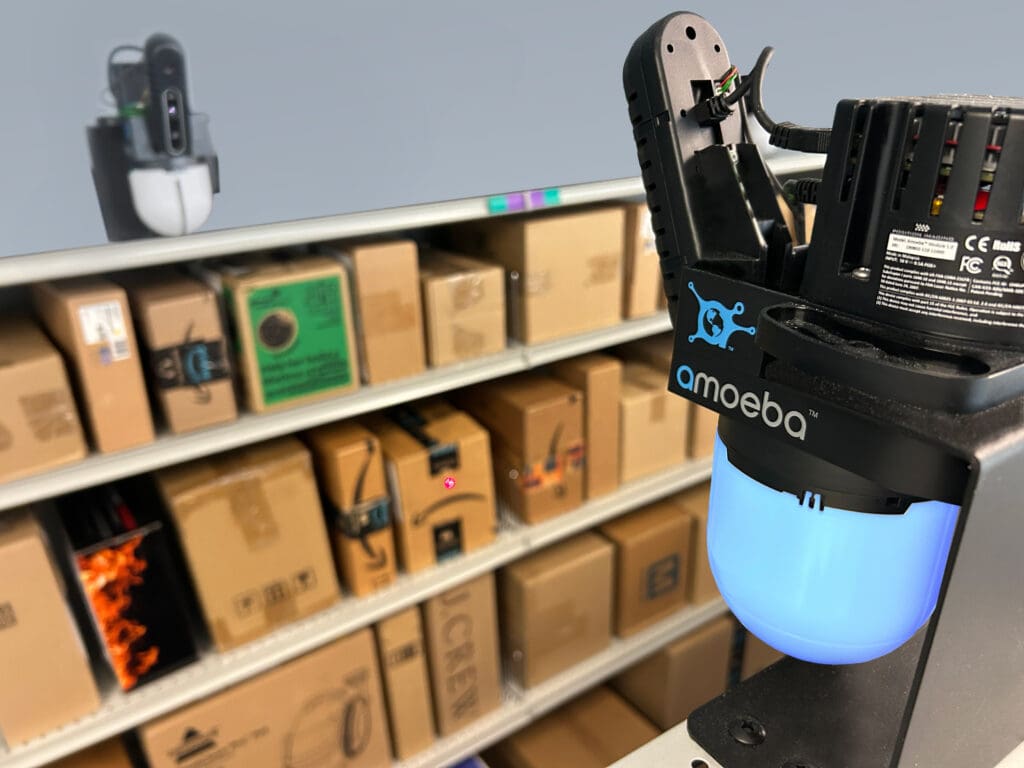
The Smart Package Room platform sits in this category. It accepts any size, shape, or temperature requirement, and it scales by adding shelving rather than buying new hardware. Residents enter with a QR code, the Amoeba Module lights and lasers point to the right shelf, and pickup is verified automatically.
4. Off-Site Third-Party Services
Companies such as Fetch ship packages to a warehouse and re-deliver to residents on a scheduled window. The trade-off is added delivery time, resident-paid fees, and confusion when packages still arrive with the home address.
The Zego package management guide also notes that third-party providers have a history of shutdowns and short operating histories, which creates continuity risk for the property.
Key Factors When Choosing a Package Delivery System for Apartments
Once you have a shortlist, the decision usually comes down to six factors. These are the ones operators ask about in second meetings, after the marketing slides are closed.
- Capacity per square foot. Lockers waste vertical space because every compartment is a fixed size. Open shelving inside a Smart Package Room platform holds two to three times the parcels per linear foot, which is the difference between a workable system and one that overflows by Black Friday.
- Item flexibility. Cold storage, dry cleaning, oversized furniture, and bulk household orders all need a place to land. A package delivery system for apartments that cannot accept those types pushes them back to the front desk and re-creates the original problem.
- Peak surge handling. Holiday season, move-in week, and Prime Day events spike daily volume two to four times above baseline. The MobileKiosk lets your property route surge deliveries into a designated overflow room while keeping every parcel on the same digital record as the main room, so a single surge day does not require new permanent infrastructure.
- Resident pickup speed. A resident with twenty seconds of friction will use your system happily. A resident with two minutes of friction will start complaining by the third pickup. The Amoeba Module and audio guidance inside the Smart Package Room system are built around sub-30-second retrievals.
- Integration with your stack. Look for clean integration with your PMS, access control, and resident-facing app. Re-keying data across three platforms is how packages get lost and how disputes turn into refunds.
- Total cost of ownership. Lockers carry hardware, software fees, and replacement cycles. A Smart Package Room solution is typically a single capital event with a service relationship attached. Run the five-year math instead of just year one.
Why the Smart Package Room System Streamlines Residential Package Delivery
The Smart Package Room platform was engineered around the failure modes of legacy lockers. Instead of asking the parcel to fit a fixed compartment, the system uses computer-vision modules to track every parcel placed on open shelving, no matter the size or shape. That single design choice unlocks most of the operational wins multi-unit package delivery teams care about.
Couriers walk into the room with credentials, scan labels, and place parcels on standard, oversized, cold, or specialty shelving. The Amoeba Module visually identifies each item, indexes its location, and triggers a resident notification within seconds.
When a resident arrives, they scan a QR code at the entrance, presence sensors confirm they are in the room, and the Amoeba Module lights blue while a red laser circles the exact parcel on the shelf. Pickup is verified the moment the resident removes the box.
Because the system relies on computer vision rather than fixed compartments, your room scales by adding shelves. A 250-unit building can handle Cyber Monday surge without adding a single locker bank, and the platform supports cold storage, dry cleaning, and oversized item zones in one room. You stop bouncing residents between three different drop locations.
The result is the workflow operators want when they need to streamline package delivery in residential buildings: couriers in and out in under a minute, residents in and out in seconds, staff freed from logging duty, and a clean digital record for every parcel that hits your property.

The MobileKiosk: Overflow Capacity for Cyber Monday and Move-In Week
Even the best fixed system needs a surge plan. Cyber Monday can push daily parcel volume two to four times above baseline, and move-in week stacks the same effect with furniture and household goods. The MobileKiosk handles those days without requiring new infrastructure.
When the main room fills, the MobileKiosk lets your property route surge volume into a designated overflow room. Couriers or staff scan each parcel at the overflow location, the Smart Package Room platform logs it the same way it would in the main room, and the resident notification fires automatically. The chain of custody stays intact, the digital record stays clean, and your building keeps moving through the surge without rebuilding the workflow.
A Seven-Step Rollout Plan to Streamline Package Delivery in Your Building
Knowing how to streamline package delivery in residential buildings starts with a clean rollout. The difference between a system that goes live in a week and one that limps along for six months comes down to following a defined sequence.
- Benchmark current volume and pain points. Pull two weeks of carrier reports and front-desk logs. Count parcels per unit per week, peak day volume, and the top three complaint categories driving tickets today.
- Evaluate available space. A retrofit-friendly Smart Package Room platform fits into any room you already have. Confirm power, network, and door swing during the walkthrough so the installation does not stall on infrastructure.
- Design the layout. Work with the implementation team to map standard shelving, oversized zones, cold storage, and the entry kiosk. Installation typically takes one to three days once the space is built out.
- Integrate access and PMS. Connect the Smart Package Room system to your access control and property management software so that resident data flows automatically and turnover updates push cleanly.
- Train staff and couriers. Run a one-hour staff session and a courier-facing flyer. Show couriers the credential workflow, the label scan, and where to place oversized items so that the first week looks like a steady state.
- Launch and communicate to residents. Send a launch email with a 60-second video and a QR code. Most residents complete their first pickup without further support.
- Monitor and optimize. Review weekly volume reports for the first 30 days. Adjust shelving allocation, expand cold storage if needed, and bring the MobileKiosk online before the first holiday season.
A property that follows this sequence typically sees a measurable drop in package-related tickets within the first two weeks of go-live and a full return on labor savings inside the first quarter.
Real-World Results: The Dime, Brooklyn
The Dime is a mixed-use tower in South Williamsburg that was managing high-density urban package volume the old way: front-desk logging, lobby stacking, and persistent resident complaints.
After installing the Smart Package Room platform, residents now retrieve parcels in under 20 seconds using QR codes, light, laser, and audio guidance. Couriers bypass the front desk and deliver directly to the room, and staff hours that used to disappear into parcel logging now go to leasing and resident engagement.
The Dime is the case study most operators look at when they want a concrete example of how to streamline package delivery in residential buildings at scale. The building transformed a daily operational liability into a marketed amenity.
The leasing team uses the room as a tour talking point, and the Net Operating Income story is straightforward: reduced labor, fewer theft incidents, higher renewal probability, and stronger lease pricing power.
Frequently Asked Questions
How do you streamline package delivery in residential buildings without overhauling your front desk?
The fastest path to learning how to streamline package delivery in residential buildings is to add a Smart Package Room platform alongside the existing front desk, then phase out manual logging as residents adopt self-service pickup. Couriers shift to direct drop-off in the room within the first week, and the front desk recovers staff hours immediately. Most properties cut package-related tickets in half within the first 30 days of go-live, without making any change to leasing operations or resident-facing policy.
What is the difference between the Smart Package Room system and traditional lockers?
Lockers use fixed compartments and limited sizes that work well for medium volume and standard envelopes. The Smart Package Room system uses open shelving with computer-vision tracking, which holds two to three times more parcels per linear foot and accepts any size, including furniture and groceries. The two systems can coexist during a transition, but the smart room is the option that scales without new hardware as volume grows. Operators usually phase lockers out within 12 months of installing the room.
How do the best drop box lockers for multi-unit residential buildings compare to a package room for high volume?
The best drop box lockers for multi-unit residential buildings handle medium baseline volume well, but they overflow during peak season because compartments are fixed. A Smart Package Room platform scales by adding shelves, so it absorbs Cyber Monday and move-in surges without new hardware. Operators evaluating how to streamline package delivery in residential buildings using a room solution avoid the locker overflow pattern entirely. They also stop paying for two systems to cover the same volume.
How long does it take to install a Smart Package Room system?
Installation typically takes one to three days once the room is built. If you are converting an existing space, the implementation team will scope power, network, and access requirements during the design phase. Most properties go from contract signature to live system in four to eight weeks, with the bulk of that time spent on integration and resident communication rather than the hardware install itself.
What does multi-unit package delivery look like during peak holiday volume?
During peak volume, surges in multi-unit package delivery can be easily delivered into overflow rooms with the MobileKiosk. The Smart Package Room platform keeps a clean digital record for every parcel. Even during a four-time spike, operators still know how to streamline package delivery in residential buildings without breaking tracking or notification. Cold and oversized zones absorb the holiday surge in items most lockers cannot accept.
Is the Smart Package Room system secure?
Yes, the Smart Package Room system is secure. Access is credentialed at the door, presence sensors monitor activity, and computer-vision modules monitor open shelving for every parcel from drop-off to pickup. Every transaction generates a digital record that is searchable for disputes. In production deployments, theft incidents drop to rare within the first quarter because residents and couriers know every interaction is logged.
Can residents really learn how to streamline package pickup in residential buildings on their own with a QR code workflow?
Residents complete their first pickup in under 30 seconds in the vast majority of deployments. The QR code at the entry, the Amoeba Module guidance, and audio prompts walk them to the exact shelf, so there is no training curve. Adoption happens without any resident training session, app installation, or staff intervention.
How does a package delivery system for apartments handle groceries and cold storage?
The cold storage zone inside the package room is a built-in refrigeration unit that maintains appropriate conditions for grocery and meal kit deliveries. Dry cleaning and oversized items get their own labeled zones, so couriers always know where to place each item type. The same notification workflow fires for cold items, with a recommended pickup window to keep food at safe temperatures. This is the gap that lockers cannot close.
What is the cost of poor package management in a residential building, and how does streamlining package delivery in residential buildings change the math?
Poor package management costs an average 250-unit building roughly $40,000 to $60,000 a year in front-desk labor alone, plus theft losses and renewal risk. Learning how to streamline package delivery in residential buildings with a Smart Package Room platform typically recovers that labor in the first year and reduces theft incidents to rare. The renewal-rate lift adds the next layer of NOI in years two and beyond, which is where most operators see the strongest five-year return.
Do residents need to download an app to use the Smart Package Room system?
Residents don’t need to download an app. Residents pick up parcels using a QR code sent in the delivery notification, opened directly in any phone browser. There is no required app, no required account, and no training session. Couriers use their existing credentials to enter the room, and most residents complete their first pickup without any guidance from staff.
Key Takeaways
Streamlining package delivery in residential buildings is no longer a back-office optimization. It is a renewal driver, a leasing differentiator, and the operational fix that returns staff hours to your highest-margin work.
- Parcel volume is growing for the next decade, with the U.S. tracking from 22.4 billion shipments in 2024 to a projected 30 billion by 2030, so any system you pick must scale without new hardware.
- Apartment residents are three to 3.5 times more likely to lose a package to theft than single-family homeowners, which puts theft prevention in the renewal-protection bucket, rather than the amenity bucket.
- Manual handoff and fixed-compartment lockers both break at peak volume, oversized items, and cold deliveries, so most properties need an open-shelving system with computer-vision tracking.
- The Smart Package Room platform paired with a MobileKiosk delivers sub-30-second pickup, accepts any size or temperature, and handles surge times such as Cyber Monday and move-in week without new hardware.
For most multi-unit residential buildings, the seven-step rollout above takes a property from baseline to a live, working system within four to eight weeks, with the renewal lift, labor savings, and theft reduction landing in the first quarter.
Ready to Streamline Package Delivery at Your Residential Building?
If your front desk is buried in parcels and your residents are sending Monday-morning emails about missing deliveries, the operational fix is already proven. Book a demo, and the Smart Package Room team will walk you through the rollout, integration, and numbers your specific portfolio should expect.