

Most operations directors at multifamily properties assume a locked front door means they don’t have to worry about package theft. It doesn’t. Preventing porch piracy in controlled access buildings is harder than it looks because the threat moves inside the lobby the moment a courier props a door open.
The problem is so persistent that the term porch piracy, which used to only describe packages snatched from a doorstep, has become more broadly recognized to include package theft of any kind, even from a multifamily property’s lobby, hallway, or package room. The U.S. Postal Service Office of Inspector General reports at least 58 million packages were stolen in 2024, with losses estimated between $5 billion and $16 billion.
With countless couriers entering and exiting the property every day, secure buildings are no longer immune to that threat. They face a different set of theft vectors than a single-family house does, and those vectors hide in the spaces residents trust most: the lobby, the mail area, and the front desk. A Multifamily Package Delivery Solution closes that gap by combining room-level access control, presence sensors, and computer vision tracking inside one auditable package room.
This guide is written for the director of operations who runs a high-rise or mid-rise community and wants package security that holds up under scrutiny. You’ll see exactly how theft occurs behind a controlled entrance, the five layers that stop it, how the Smart Package Room system catches a wrong-package grab in real time, and the metrics that prove to ownership and insurers that your building is protected. And best of all, the additional burden to staff is minimal.
Why Porch Piracy Still Happens in Controlled Access Buildings
Controlled access makes package theft more challenging, but it doesn’t eliminate it. Four vectors account for most parcel losses inside secured buildings, and the national numbers show why operations teams can’t ignore them.
The Theft Vectors Hiding Inside Secured Buildings
Here’s where the losses actually come from:
- Tailgating, with the explosion of ecommerce, courier delivery hauls are larger than ever. Think dollies full of large boxes and oversized tote bags stuffed with standard packages, bagged parcels, and envelopes. Couriers prop the front door open as they run back and forth from the delivery vehicle to the entrance, leaving the previously secured door wide open.
- Insider theft, a resident or visitor steals a package from an area that nobody is tracking, such as a pile in the lobby, a hallway, or outside of the mailroom.
- Misdelivery exploits, a resident takes the wrong box, by accident or on purpose, and no delivery record exists to flag or retrieve it.
- Front desk handoff gaps, staff accept a delivery without a signature, a timestamp, or a log entry, so the package enters a blind spot the moment it leaves the courier’s hands. Closing that gap will facilitate a front desk workload reduction because self-service pickup removes the manual handling step where packages go missing.
All four of these theft vectors live past the front door, in the part of the building that residents assume is safe. It’s that assumption that can make secured buildings a high-opportunity target.
Why High-Rises Aren’t as Safe as Residents Assume
When properties are forced to accommodate hundreds of packages daily, porch piracy shifts from the doorstep to the lobby. The more deliveries that funnel through a building, the more chances a thief has to grab a package and disappear from the premises.
Vivint found that apartment residents are 30% more likely than house residents to have a package stolen, and that urban areas see a higher theft rate (32%) than suburban (24%) or rural (17%) areas. Because they are dense and urban, high-rise communities sit at the intersection of both risk factors. Layer in the volume problem, and the math gets worse.
For a 200-unit building, even a small theft rate turns into real dollars, real disputes, and permanent damage to resident trust. The takeaway for operations managers is to control the building entrance first, then secure the property’s interior.
Five Layers of Theft Prevention for Controlled Access
No single tool stops package theft. The buildings that successfully prevent it invest in systems that stack five layers or more, so that if one fails, the next one holds. Here’s the operational framework of one such platform, the Smart Package Room system, from the front door to the audit log.
Access Control Beyond the Front Entrance
Your front entrance is the first security checkpoint, but it’s not the only one. One mistake secured buildings make is treating lobby access as holistic package security. Once a courier or resident is through the front door, an unsecured package pile is fair game for porch pirates.
Room-level access control fixes that. The Smart Package Room system features a locked, credentialed entry, separate from the building’s front door. Couriers use key cards and staff use customized PINs to deliver packages into the room. Residents use a unique QR code or PIN to pick up, so only the three approved groups (couriers, residents, and property staff) are permitted access into the room.
That second layer of security turns the package room into a controlled space inside an already controlled building. Residents can’t wander in and browse. A visitor who tailgated through the lobby won’t be able to breach the locked door. And because every credential ties to an identity, entry itself becomes part of the record. You’re no longer trusting the front door to do a job it was never built for.
Computer Vision Tracking via the Amoeba Module
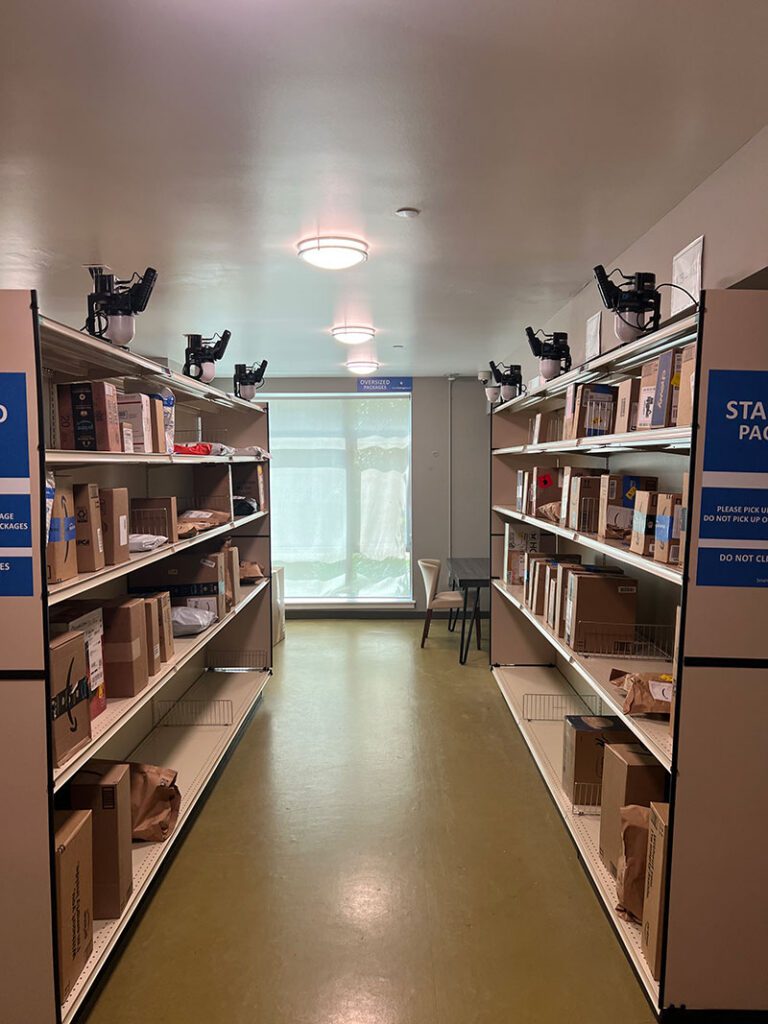
Knowing who enters your package room is just half the picture. You also need to know what happens to each package on the shelf. The Amoeba Module is a computer vision-enabled unit mounted on all standard shelves inside the Smart Package Room solution. The modules track each standard package’s precise location in real time, from the moment it is placed on the shelf to the second a resident picks it up. If a package is moved when it shouldn’t, the system sees it. That precise, location-based awareness provides time and location stamped precision to post-incident reviews.
Older setups rely on a resident or staff member noticing that a box is gone, then hunting through footage after the fact. Computer vision tracking flips that, flagging the problem as it happens rather than hours later. The Amoeba Module covers the standard zone specifically, while flat, oversized, cold storage, and dry-cleaning items are secured in zone-tracked areas. For the high-volume standard shelf, where the most packages go and risk of theft is the greatest, you get continuous, automated tracking that no front desk team could match by hand.
Round-the-Clock Monitoring of Everyone in the Room
If packages are tracked via computer vision, how are people who enter the package room tracked? In the case of the Smart Package Room system, presence sensors are used to monitor the movements of people who enter the room. Mounted on the ceiling, wall, or shelves, presence sensors provide a layer of accountability that confirms the right person is in the room at the right time, 24/7. When a resident enters with a valid QR code or PIN, the room knows it.
The around-the-clock element matters because theft tends not to keep business hours. A package delivered at 9 p.m. is just as exposed as one delivered at noon, especially when the front desk closes overnight and staff aren’t around to watch the room. That’s why presence sensors monitor the room 24/7. They provide your staff with a continuous account of every person who enters and exits the room, and what they do inside. This kind of reviewable coverage becomes critical the moment a package goes missing and you need to reconstruct exactly who was in the room and when.
Laser, Light, and Audio Guidance for Pickup Verification
The fourth layer of theft prevention is the package pickup guidance system, which directs residents to the correct package, so theft and mistakes are less likely. When a resident enters through the access-controlled package room door, the system uses laser, light, and audio guidance to point them to the exact shelf or zone holding their delivery. The light on the Amoeba Module pulses to attract the residents’ attention, as the audio prompt guides them to the appropriate shelf, where a circling laser confirms which package is theirs.
The effect is twofold. First, package pickup goes faster because residents aren’t searching the shelves or being directed to the wrong parcel. Second, verification is built into the act of picking up. Residents are guided to their package and only their package, removing the possibility of an incorrect pickup. If they reach for the wrong parcel, the system recognizes this and alerts them. Guided pickup also keeps the room orderly during peak traffic windows, when several residents arrive at the same time. Each resident is quickly routed directly to their parcel, at which point they pick it up and exit the room.
Audit Trail and Chain of Custody Documentation
The final layer is the one that protects you after the fact. Every action inside the room—including delivery, entry, pickup, and any flagged event—is logged with a timestamp and location data. Together, those entries form a complete digital chain of custody for each package, from the courier or staff scan at delivery to the resident pickup. When a resident disputes a delivery, there’s no need to launch an investigation. Simply open the portal and review the record. The digital audit trail shows when the package arrived, where it was placed, who entered the room, and when it was removed. That documentation does two jobs. It resolves disputes in minutes instead of days, and it gives the property a defensible record if a resident escalates their claim.
Precision tracking at this level also deters insider theft, because residents and staff know that the room keeps an account of everything. A locked door tells people they can’t get in. A digital audit trail tells them that if they do something they shouldn’t, there’s a record.
This final layer is the one that provides proof for the rare situations where it’s needed.
How the Smart Package Room System Stops Porch Piracy Inside the Room
When those five layers come together in one place, here’s what happens when a resident, or a thief, steps into the Smart Package Room system.
Authentication and Guided Pickup
Entry starts with proof of identity. Residents scan their unique QR code or enter a PIN at the kiosk, and only then does the door allow them access. Couriers use key cards or PINs to deliver packages into the room, never the resident QR code. This keeps delivery and pickup credentials cleanly separated.
Once inside, residents aren’t left to hunt. Audio guidance directs them toward the right zone, then light and laser guidance pinpoints their exact package on the shelf. The whole pickup process takes seconds, not minutes. This is where access control and guided pickup do the quiet work of theft prevention. Because the resident is authenticated at the door and routed straight to their own delivery, there’s limited opportunity for them to browse an open pile or drift toward a shelf that isn’t theirs.
The MobileKiosk handles the delivery side, letting couriers log each package in seconds using optical character recognition (OCR). Every scan starts the digital chain of custody, so the package is accounted for the instant it enters the room.
Catching the Wrong Package Grab in Real Time
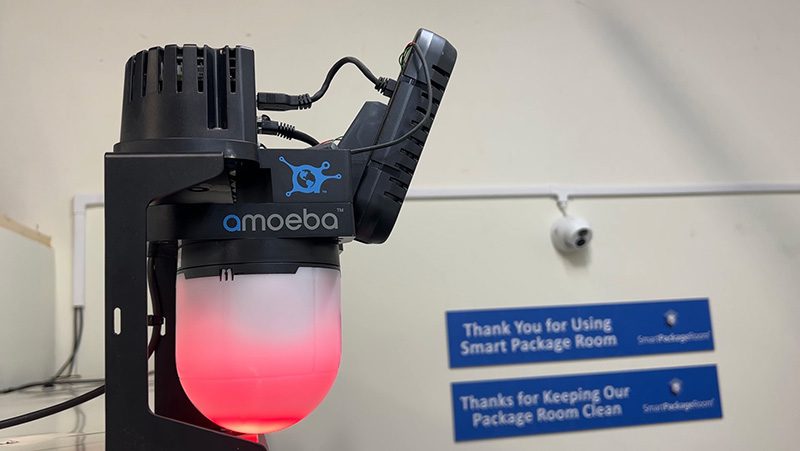
The system’s sharpest defense occurs when a resident reaches for the wrong package. If a resident picks up a parcel that isn’t theirs, the Amoeba Module flashes red to flag the mistake in real time, and audio prompts instruct them to immediately put it back.
Most of the time, incorrect pickups are harmless mistakes that can easily be corrected on the spot. When that’s not the case, however, the system captures the data it needs to help with an investigation. Presence sensors record when residents, staff and couriers enter the room, so all theft investigations start with evidence instead of guesswork. Due to the system’s accuracy and ease of use, your team won’t need to scrub through hours of footage. The red flag happens the moment the wrong package leaves its spot. Pair that with the digital audit trail and you can see exactly who entered, what they touched, and when they left.
For a director of operations, that’s the difference between hoping a package theft is seen by the system and knowing the room documented it. Preventing porch piracy inside the room comes down to a system of detection that works in the moment, not after the loss.
Insurance and Liability Implications of Theft Prevention
Theft prevention is a win for operations just as much as it’s an asset-protection story that ownership and insurers care about.
Start with premiums. When you can demonstrate layered theft prevention that includes access control, computer vision, presence sensors, and a full audit trail, you demonstrate to insurers that you employ a system that provides hard evidence. A documented system like this gives you the hard proof that verbal promises never will. The digital audit trail does the heavy lifting on claims. On the rare occasions when an incident occurs, the system’s complete digital chain of custody supports speedy claim resolution because the record shows exactly what happened and when. Adjusters will move faster on documented losses than on disputed ones. The system’s documentation defends the property in resident disputes as well. When a resident claims a package was stolen from the room, the chain of custody record either confirms the loss or shows that the package was picked up, which prevents your property from absorbing unnecessary claims.
Data protection matters here too. The Smart Package Room system aligns with ISO/IEC 27001 and ISO/IEC 27701, the international standards for information security and privacy management, so the resident and delivery data behind your audit trail is handled in accordance with a recognized benchmark.
Measuring How Effectively You’re Preventing Porch Piracy
You can’t prove the value of prevention without measuring it. Track these four metrics from the quarter before you implement a system through the quarters after installation, so the improvement is visible to staff, management, and ownership:
- Theft incidents per quarter, set a clear baseline before implementation, then watch the post-implementation number, which should drop sharply once the system is in place.
- Dispute resolution time, measure how long it takes to resolve a package dispute, because a system with a full audit trail resolves them in minutes instead of days.
- Insurance claim frequency, count how often package theft drives a claim, since fewer documented losses mean fewer claims and more satisfied residents.
- Resident satisfaction with package security, survey residents on whether they trust the system, because perceived security feeds retention and quietly drives renewals.
When you review these metrics each quarter, you can establish a porch piracy prevention scorecard that you can share with key stakeholders. The goal is to highlight a trend that shows theft incidents falling, disputes closing faster, and residents reporting that they trust the room.
Frequently Asked Questions about Preventing Porch Piracy in Controlled Access Buildings
1. How Do You Effectively Prevent Porch Piracy in Controlled Access Buildings?
Preventing porch piracy in controlled access buildings works best as a layered system. Start with room-level access control, so the package room has its own credentialed entry beyond the building’s front door. Add computer vision tracking through the Smart Package Room system’s Amoeba Module to watch all standard packages in real time, presence sensors to monitor who’s in the room 24/7, and a full digital audit trail that logs every delivery and pickup. Each layer covers a different theft vector, from tailgating to misdelivery. Together, they form a truly preventative system that makes packages nearly impossible to take without a record.
2. Does Porch Piracy Actually Happen in High-Rise Buildings?
Yes, it occurs more often than residents expect. Vivint found that apartment residents are 30% more likely than house residents to have a package stolen, and urban areas see a higher theft rate than suburban or rural ones. High-rises are dense and urban, so they carry both risk factors at once. The type of theft just looks different from that on a single-family porch. It shows up as tailgating at the entrance, insider grabs from open lobby piles, and packages taken by the wrong resident.
3. What Technology Stops Package Theft Inside an Apartment Building?
Package management solutions such as the Smart Package Room system feature core technologies that work 24/7 to prevent theft. Access control at the package room door restricts who can enter, with key cards for couriers and a unique QR code or PIN for residents. Computer vision tracking, through the Amoeba Module, tracks the location of each standard package on the shelf and flags a wrong-package pickup in real time. Presence sensors monitor personnel in the room around the clock, so every entry and exit is recorded. Add a digital audit trail on top, and you have detection, deterrence, and documentation working together as a layered defense against theft.
4. How Do Presence Sensors Help Prevent Porch Piracy in Apartment Buildings?
Presence sensors are ceiling, wall, or shelf-mounted units that monitor personnel in the room 24/7. They confirm who is present in the room, and when. They provide a continuous account that is central to preventing porch piracy in controlled access buildings, because theft doesn’t keep business hours and a front desk that closes overnight can’t watch the room. When a package goes missing, the footage recorded by the presence sensors lets you reconstruct exactly who entered the room and when, so an investigation starts with a clear record of the incident.
5. Can a Package Room with Computer Vision Detect a Theft as it Happens?
Yes. That’s the advantage of the precise nature of computer vision tracking. The Amoeba Module tracks each standard package’s location on the shelf, so when someone picks up a parcel that isn’t theirs, the system flags it immediately. An audio prompt tells the person to return the package, and the module light flashes red until the package is returned. Most of the time these measures correct an honest resident mistake. When it doesn’t, the room has a clear log of the action that occurred, so a theft investigation begins with evidence. That’s why it’s important that detection happens in the moment, not hours after the package is gone.
6. What Is the Difference Between Porch Piracy in Single-Family Homes and Controlled Access Buildings?
In single-family homes, porch piracy is an outdoor crime. A package sits on a doorstep, and a thief grabs it without entering the property. Preventing porch piracy in controlled access buildings is a different problem, because the theft happens inside the building. This occurs because thieves tailgate through a propped door, insiders steal from an open lobby pile, and residents (mistakenly or not) take a package that isn’t theirs. The fix is different too. Single-family theft prevention relies on doorbell cameras, while a secured building needs room-level access control, computer vision tracking, and a digital audit trail.
7. How Does Access Control Reduce Package Theft in Apartment Buildings?
Access control limits who can enter the package room and reach the packages in the first place. Instead of leaving deliveries in an open lobby or at an unattended desk, the package room gets its own locked, credentialed entry. Couriers enter the room using key cards, and residents pick up deliveries using a unique QR code or PIN, so only couriers, residents, and property staff ever reach the shelves. A visitor who tailgated through the front door still encounters a locked package room. And because every credential ties to a courier, resident, or staff identity, entry itself becomes part of the audit trail.
8. What Should You Do If a Package Is Stolen from a Controlled Access Building?
Start with the record. If you invested in the Smart Package Room system to prevent porch piracy in controlled access buildings, open the portal and review the audit trail to see when a package arrived, where it sat, and who entered the room. Notify the affected resident of that timeline, then coordinate with the carrier on their claims process. If the loss is confirmed, file an insurance claim using the chain of custody documentation as support. The same record often resolves the issue without a claim, by showing when and by whom the package was picked up.
9. Are Package Theft Rates Rising in Urban High-Rises?
The national trend points upward. The U.S. Postal Service Office of Inspector General reported that at least 58 million packages were stolen in 2024, with losses between $5 billion and $16 billion, as ecommerce volume keeps growing year over year. Urban areas carry a higher theft rate than suburban or rural ones, and high-rise properties concentrate deliveries through a single entry, which multiplies the opportunities for theft. As package volume climbs, the buildings that don’t layer their defenses see the problem grow with it.
10. How Do You Start Preventing Porch Piracy in Your Controlled Access Building?
Begin with an audit of your theft vectors. Walk the path a package takes from the courier’s hands to the resident’s and mark every point where it changes hands without a record. Vulnerabilities include the propped door, the open lobby pile, and the unattended desk. Then layer your protections, with room-level access control first, followed by computer vision tracking, presence sensors, and a full digital audit trail. Finally, implement a system that ties those layers together. Preventing porch piracy in controlled access buildings is a project you can scope in an afternoon and solve with a single install. If you want help sizing it for your building, talk to a package management specialist before your next delivery surge.
The Bottom Line on Package Theft
Preventing porch piracy in controlled access buildings comes down to the simple truth that a locked front door is where security starts, but not where it ends. Keep four points in mind as you plan.
- Theft happens even in secured buildings, tailgating and insider theft are real threat vectors that live beyond the front door.
- Layered prevention works, the combination of access control, computer vision tracking, presence sensor coverage, and an audit trail closes each vector in turn.
- Computer vision detects anomalies in real time, the Amoeba Module flags a wrong package pickup before the box ever leaves the room.
- Audit trails defend the asset, chain of custody documentation reduces your dispute exposure and speeds up insurance claims.
Set these preventative layers up before the next delivery surge, and your controlled access building will become fully controlled.
Preventing porch piracy in controlled access buildings means going beyond intercoms and lobbies. Request a consultation with our expert team to see how the Smart Package Room system layers access control, presence sensors, computer vision, and a full digital audit trail to protect every package from delivery to pickup, without adding a single person to your front desk.