


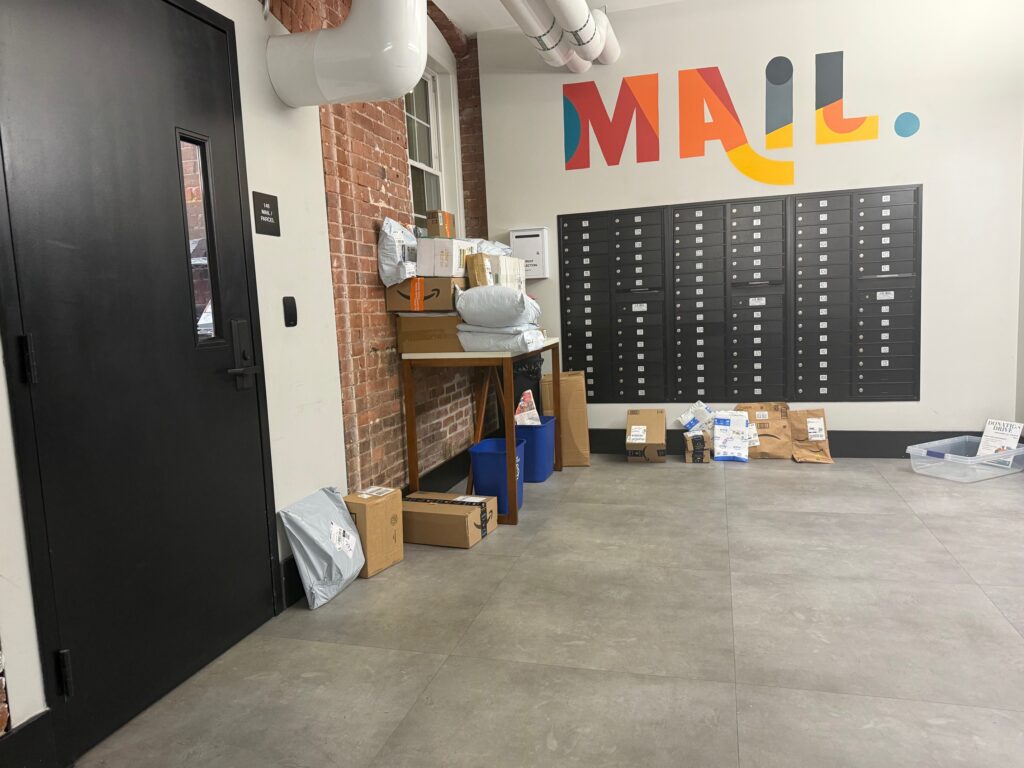
Step into the lobby of any multifamily property and it’s easy to spot a package management system that’s in need of an upgrade. Couriers are queued up all day long waiting to deliver their package hauls. They brought large tote bags full of standard packages and envelopes, along with dollies full of large boxes. Oversized parcels line the hallway–televisions, workout equipment, furniture, and more. Staff are fielding calls from frustrated residents who can’t locate their packages. And yet, couriers continue to wheel dollies and haul canvas tote bags full of packages through the lobby. It never stops.
U.S. parcel volume reached 22.4 billion shipments in 2024 and is projected to grow at roughly 5% annually, reaching 30.5 billion by 2030. The volume isn’t seasonal anymore. It’s structural. And most package management solutions were never built for this world.
If you own a multifamily property, or if you manage operations at one, you know this pain point all too well. You may have even looked at solutions for how to resolve it. This article will put numbers to the package management challenge that you’re feeling every day. It will shed light on why you and your staff are feeling crushed with every subsequent delivery. And it will give you a handy guide for understanding when it’s time to upgrade to a higher-tech system.
The Package Volume Reality, and Why It’s Not Slowing Down
eCommerce has permanently changed the delivery math for multifamily properties. Between 2019 and 2020 alone, U.S. parcel volume grew nearly 40%, reaching 20 billion packages, and projections put that number at 32 billion by 2028. The average American now receives 3.5 packages per week, which amounts to roughly one parcel a day for couples. Online sales rose 9% from 2023 to 2024, outpacing total retail growth two to one.
The impact at the property level is felt daily. Forty-eight percent of residents now receive three or more packages weekly, a 20-percentage-point increase from pre-pandemic levels. Multifamily properties report anywhere from 10 to 20 courier visits per day. During major shopping events like Amazon Prime Day and Cyber Monday, that number surges even higher.
Properties that were manually managing packages a few years ago with a locked room or a locker bank are no longer equipped for this increasing volume. If this is you, do you already feel like the influx of packages has overwhelmed your current setup?
What Insufficient Package Management Is Costing You
The cost of manual or inefficient package management rarely shows up as a single line item in your budget. Instead it quietly impacts every aspect of property operations, consuming staff time, increasing payroll costs, interrupting leasing activities, lowering resident satisfaction, and contributing to missed lease renewals.
The staff time drain is significant.
At a typical community of around 370 units, 125 or more packages may arrive daily. This number can double during the holidays and peak shipping seasons. Each package requires an average of five minutes of staff handling time across its full lifecycle. This includes receiving, verifying, logging, and securing the package, then notifying the resident, and completing the final handoff. At 75 packages per day, that’s more than six hours of your team’s working day consumed by package management alone.
To put a dollar figure on it, if your leasing associate earns $20 per hour and is personally handling six hours of package-related tasks daily, that’s roughly $120 per day. Scale that out and you’re wasting approximately $2,500 per month, and approaching $30,000 per year in labor cost allocated to an activity that has nothing to do with leasing, resident engagement, or NOI.
If you know your daily package haul and hourly staff rate, you can calculate how much time and money you’re losing to package mismanagement. See for yourself with our Cost and Labor Savings Calculator.
That calculation captures wages; however it doesn’t account for the prospect calls that went unanswered while someone was sorting deliveries, the lease renewal conversation that was rushed, or the maintenance request that was delayed because the front desk was managing a pickup. Those are real opportunity costs that never appear in any package management budget line.
Resident experience is negatively affected.
Resident turnover averages approximately $4,000 per unit when accounting for lost rent, make-ready costs, marketing, and leasing commissions. Because package management is a near-daily touchpoint for many residents, a chaotic or unreliable pickup experience is likely to contribute to non-renewals. Plus, one out of three multifamily residents have experienced package theft. Residents who don’t trust that their deliveries are secure are residents who will look elsewhere at renewal time.
Signs Your Current System Has Hit Its Limit
Are you wondering whether your setup has crossed the line from manageable to broken? Here’s a quick self-check. If more than a few of these apply, the cost of waiting is likely higher than the cost of upgrading:
- Packages regularly overflow into lobbies, hallways, or back-of-house areas
- Residents frequently call the front desk asking for help locating their packages
- Your storage room or lockers hit capacity multiple times per week, not just during the holidays
- Oversized deliveries have no consistent, secure home
- Staff are spending hours per day on manual package intake, sorting, and handoffs instead of on leasing or resident engagement
- You’ve had a package go missing, or can’t prove what happened to it when a resident disputes a delivery
- Your current setup has no digital chain of custody
Why Technology, Not More Staff, Is the Answer
Adding headcount will not solve a structural problem. It will, however, increase the payroll costs of an inefficient system, which is no way to future proof package management. Properties that are successfully handling two to three times more packages while maintaining high service levels are doing so through automation, not additional hiring.
AI-powered, computer vision-enabled solutions like the Smart Package Room system automate parcel intake, resident notification, package location tracking, and self-service pickup. The system is designed to meet the expectations of modern residents who use their smartphones for every step of the shopping journey, from placing an order online to retrieving the package upon arrival. Plus, it significantly reduces the operational burden associated with package management.
The open shelf, open zone design used in the Smart Package Room system accommodates up to three times more packages per square foot than traditional lockers. It handles all delivery types without exception, including standard parcels, flat packages, oversized items, dry cleaning, and cold storage items.
By contrast, package lockers are often positioned as the “tech solution,” but there are a few well documented reasons why they fall short in today’s shopping and shipping landscape. Fixed locker compartments are one-size-fits-all by design, which means a small envelope and a large shoebox take up the same amount of space, wasting capacity with every parcel. Lockers also can’t accommodate oversized deliveries, forcing couriers to dump them in an unsecure location or contact staff to resolve the situation. Whole locker bays fill up during peak delivery periods. Finally, proprietary app requirements create unnecessary friction for residents.
The right technology is designed to scale with volume. You need a solution that works for every delivery type and reduces the staff burden of package management, while also considering the needs of residents.
What Upgrading Looks Like
One of the most common reasons operators delay upgrading their package management system is the assumption that it’s a major, disruptive project. In practice, it’s far more accessible than most expect.
Installation of the tech-enabled Smart Package Room system in a prepared space typically takes one to three days. The system works for both new construction and retrofit projects. Existing spaces like garages, storage rooms, or offices can be converted with relative ease. For new developments, in-house room designers work directly with architects to integrate the package room into the property’s design from the start.
On the resident side, there’s no app to download. Pickup uses a secure QR code or PIN, while laser, light, and audio guidance directs residents to their package within seconds. Automatic text and email notifications are sent the moment a package is inducted into the system. No front desk involvement is required for resident package pickup.
For property staff, the system integrates seamlessly with leading property management platforms including Entrata, Yardi, and RealPage, plus access-control solutions like ButterflyMX. A digital chain of custody tracks every package from drop-off to pickup, and the staff portal allows for fast audits, courier verification, and footage review when needed.
The operational results speak for themselves. Properties that have implemented AI-powered package room technology have seen staff requirements for package management decrease dramatically, resident pickup times slashed, and hundreds of thousands of deliveries processed without a single misplaced or lost package.

When Should I Invest in an Upgraded Solution?
The honest answer to “when is the right time to upgrade?” is before the next wave catches you scrambling. Whether that’s the holiday shipping surge, Amazon Prime Day, or simply next Tuesday’s delivery slate, the cost of your current setup is already accumulating. Only now you realize that you’re seeing it in staff hours, missed leasing activity, resident frustration, and theft risk.
The technology to solve it is available, proven, and more accessible to implement than most operators assume. The question is whether you’ll act now or after the next overflow.
Ready to see what upgrading would mean for your property? Use the Smart Package Room Cost & Labor Savings Calculator to see exactly what your current setup is costing you. Not convinced? Schedule a demo with our package management experts today to see how much time and money you could be saving.