


Student housing package management is unlike any other residential category. The volume curve is not driven by holiday shopping or market-rate move turnover. It is driven by the academic calendar, which compresses an entire semester of parcel volume into one move-in week and resets the cycle three times a year. For residence life directors and purpose-built student housing operators looking at student housing package management, that curve sets the bar every platform has to clear.
The operations playbook that works for a market-rate apartment breaks the first week of August. A 1,000-bed property that handles 4,000 parcels in a normal week will absorb 15,000 in the seven days of move-in, with care packages, textbooks, and mini-fridges arriving alongside furniture and bedding. The Smart Package Room for campuses is built for that surge week.
Volume keeps climbing year over year. U.S. shipments rose to 22.4 billion in 2024 and are on track to reach 30 billion by 2030. Campus properties absorb more than their share of that growth, and most of it lands in a handful of peak weeks rather than across the academic year.
If you run student housing operations and have already decided your package workflow needs a real platform, this guide walks you through the choice. You’ll get the move-in volume math, four setups compared head to head, where smart lockers hold up and where they fail, the move-in case for a campus-grade package room, SIS and ResLife integration, a semester rollout sequence, and a 1,200-bed move-in walkthrough.
Four Volume Phases That Define Student Housing Package Management
Student housing runs on a calendar no apartment operator faces in the same shape. Three or four times a year, the building empties, refills, or pivots, and your package workflow has to absorb each shift without losing track of a single parcel. Four distinct phases drive the year, and each one asks something different from the system.
- Move-in surge (mid-August). Ninety days of parcel volume compress into a single week as care packages, dorm essentials, bedding, mini-fridges, and pre-shipped textbooks all arrive in the same dock window.
- Fall steady state (September through November). Volume settles into a predictable weekly rhythm, but the totals stay high. October and November both run as second-tier peak months behind move-in, with online ordering of school supplies, clothing, and care packages continuing through the semester.
- Finals surge (late November and early December). The inbound mix shifts to study-snack subscription boxes, last-minute textbook drops, and parent care packages timed to the exam window. Winter break then drops volume to near zero for two to three weeks.
- Spring repeat and summer trough. Spring follows the same arc at lower volume. A property that processed 15,000 parcels in seven days in August might process 300 a week through July, and the dorm sits nearly empty.
Any platform that handles one phase well but breaks in another is the wrong fit for student housing package management. The right system absorbs all four without rebuilding the workflow each semester.
Why Move-In Week Breaks Systems That Work the Rest of the Year
Move-in week is where student housing package handling stops looking like any other apartment building. A quick walk through the numbers on a 1,000-bed property shows why that single seven-day window decides what kind of system you actually need.
In a normal week, a 1,000-bed property handles about four parcels per bed: roughly 4,000 parcels a week, or 16,000 a month. That is the figure most vendor demos quote, and the figure most platforms are built around.
Move-in week looks nothing like that. During the seven days students arrive, parents pre-ship dorm essentials, textbooks, bedding, mini-fridges, and care kits ahead of the drive-in date, and volume per bed jumps to 12 to 20 parcels.
The same 1,000-bed property absorbs 12,000 to 20,000 parcels in the week it normally handles 4,000. At two minutes of staff handling per parcel and a fully loaded $25 per hour labor cost, that compresses $50,000 to $83,000 of labor into a single week.
That is as many parcels in seven days as the property handles in three to four normal months. A system sized for the September baseline gives out by Wednesday of move-in, and the fallout shows up as resident complaints, calls from parents, and a residence life team that loses two weeks to package triage. The only meaningful test for any platform is whether it survives move-in.
The Four Common Student Housing Package Management Setups, Compared
Most operators looking at student housing package management end up choosing between the same four setups. The table below shows how each one holds up across the academic calendar, with the move-in spike, finals, and break weeks built in.
| Academic-calendar variable | Smart lockers | Smart Package Room platform | RA-managed front desk | Off-site third-party service |
|---|---|---|---|---|
| Move-in week handling (3-5x surge) | Compartments fill on day 2 of move-in; overflow falls back to lobby stacking | Open shelving holds 3x the volume of lockers; overflow rooms easy to set up for peek weeks | Breaks at day 1 of move-in; RAs become package sorters | Warehouse becomes the bottleneck, multi-day re-delivery windows |
| Finals-week capacity | Often near capacity from late-November study-snack box wave | Absorbs the secondary surge alongside study supplies and lab kits | Front desk reverts to manual triage during exam week | Re-delivery windows lengthen as carriers prioritize residential routes |
| Break-period downtime cost | Hardware and software fees continue regardless of volume | Software amortizes against academic-year volume, hardware idles cleanly | Staff still scheduled but processing minimal volume | Provider fees continue, residents largely off campus |
| Summer dormancy (zero volume) cost | Full software fees on near-zero parcels, replacement cycles unchanged | Single platform idles, no per-locker overhead, ready for fall reset | Front desk closed or skeleton-staffed | Continuity risk if provider exits market during 90-day quiet period |
| Parent care-package handling | Standard-size boxes fit, oversized care boxes get rejected | Oversized zone accepts large care packages, cold zone supports food shipments | Stacked on front desk, frequent misdelivery to wrong student | Parents pay re-delivery fees, often unexpectedly |
| RA / ResLife staff workload | Reduced compared to manual, still spike during overflow | Minimal RA touch, ResLife focused on programming and student wellness | RAs absorb 20 plus hours a week during move-in and finals | Front desk fields re-delivery questions and forwarding requests |
| FERPA compliance and student record access | Resident profile data sits in vendor platform, audit trail vendor-dependent | Native SIS sync, audit trail tied to student record, FERPA-aligned controls | Manual logbooks, FERPA risk on paper records and informal handoffs | Off-site provider holds student PII, harder to audit at the property |
| Summer turn cycle (resident roster reset) | Manual deprovision of every locker code at turnover | Bulk roster sync from SIS, ready for the August cohort | Manual roster updates, frequent credential errors on move-in day | Provider reset depends on contract terms, often slow |
A pattern surfaces quickly. Smart lockers buy security and 24/7 access on a steady-state week and lose those advantages during move-in and finals. RA-managed front desks fail at every surge point.
Off-site services move the bottleneck to a warehouse the parents and the leasing team cannot see into. The Smart Package Room platform is the model that absorbs the academic calendar’s four phases without forcing a workflow change in any of them.
What Smart Locker Student Housing Actually Looks Like in Production
Smart locker student housing has a real role in the category, and the leading platforms have shipped across campuses for over a decade. Operators considering lockers as the primary system should understand both strengths and limits in production.
A locker bank installed near the entrance gives students 24/7 access without staff intervention and produces a clean digital record of every pickup. The NMHC and Grace Hill 2024 Renter Preferences Survey found that 73% of residents want secure self-service 24/7 package access and are willing to pay an average of $37.16 per month for it. Lockers keep parcels safe and produce a clean record of who picked up what and when.
The limits show up on the first day of move-in week. Standard locker compartments are simply not big enough for mini-fridges, microwave boxes, oversized care packages, or pre-shipped bedding. The lockers fill within two days of move-in, and the property ends up stacking packages in the lobby right as parents are walking through the door. The same problem hits again during the late-November study-snack rush, and refrigerated meal kits never fit in a standard locker at all.
Summer is the second limit. Software fees and replacement cycles run regardless of volume, so a property paying for 400 compartments in August pays the same in July when only 30 students are on campus. Lockers are an honest fit for smaller properties with predictable week-to-week volume. They are an awkward fit for a purpose-built student housing property that has to absorb all four phases of the academic year.
Why the Smart Package Room for Campuses Outperforms During Move-In
The difference between a campus-grade Smart Package Room system and a locker bank shows up on day three of move-in, when locker compartments are full and the package room still accepts parcels at the same speed it did on day one. The platform was built around what move-in week actually looks like, which is why the peak weeks come and go without packages ever stacking in the lobby.
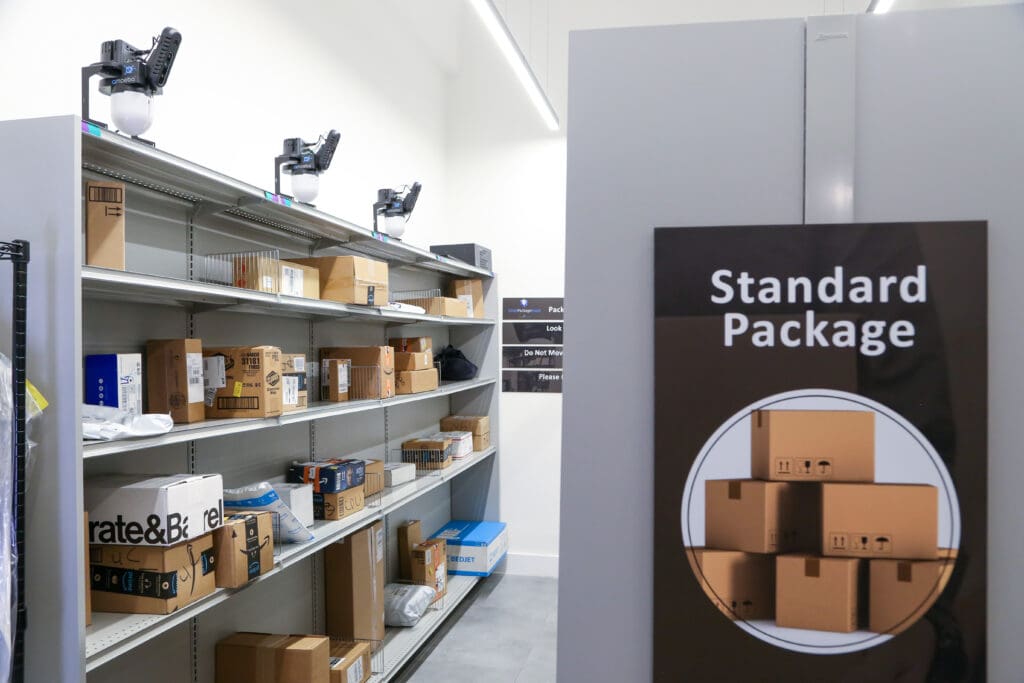
The room scales by adding shelves rather than buying new hardware. Couriers enter with credentials, scan labels, and place parcels on standard, oversized, cold, or specialty shelving. The Amoeba Module identifies each item, indexes its location, and triggers a student notification within seconds.
When a student arrives, they scan a QR code at the entrance, presence sensors confirm they are in the room, and the Amoeba Module lights blue while a red laser circles the exact parcel on the shelf.
Move-in week is when the room earns its keep. Mini-fridges, microwaves, bedding, and oversized care boxes go to the oversized shelves instead of getting turned away for being too big. Cold meal kits go into the built-in refrigeration unit inside the room. .
Care packages stay in their own zone, separate from the textbook stacks. Each student walks in, sees the room light up, and walks out with the right parcel within 30 seconds.
Throughout the August peak, the MobileKiosk inside the main room keeps the intake moving at full speed, scanning parcels into the system in seconds. When even that pace isn’t enough, staff open an easy-to-set-up overflow room to absorb the additional surge. Every parcel keeps a clean record across both spaces, and resident notifications fire the same way.
Mailroom Software for Student Housing: Integrating with SIS, ResLife Platforms, and Parent Portals
Mailroom software for student housing has to talk to systems that no market-rate property cares about. Four integration surfaces separate a serious campus platform from a multifamily setup that just got rebadged for student use.
- Student Information System (SIS). Banner by Ellucian, Ellucian Colleague, and PeopleSoft Campus Solutions cover most of the installed base at four-year institutions. The platform needs native API hooks for enrollment status, housing assignment, meal plan flag, and contact preferences. A platform missing those API hooks turns every semester’s roster into a manual rebuild for the housing team.
- ResLife platform. StarRez and RMS Mercury run housing assignments at most major institutions, and a campus-grade package platform syncs room assignments, transfers, and turnover events every fifteen minutes or faster. Without that link, a student who switches rooms in October starts getting credential errors the next day.
- Parent portal and FERPA. Parents want delivery confirmation; FERPA says the platform cannot share a student’s record with anyone but the student. The right setup routes notifications to the student first and lets them opt in to parent visibility, so the workflow stays FERPA-safe and parents still get the updates they want.
- Access control. Student ID badges integrate with the package room door, and audit trails tie back to the registrar’s record. A package room cut off from the registrar’s system ends up handling a follow-up ticket every time a student’s credentials change.
Native integration with SIS, ResLife, the parent portal, and access control is what separates a platform that survives all four phases of the academic year from one that turns the housing team into a manual integration layer every semester.
A Semester Rollout Sequence: Pre-Term, Term, Finals, Break Operations
Think of the sequence below less as an installation and more as a calendar the property runs alongside the academic year. Each phase has its own setup work. A property that follows the sequence absorbs the August peak, stays steady through October, manages the late-November snack wave, and rolls into spring without any of those phases turning into a fire drill.
- July, pre-term preparation. Run SIS roster sync as housing assignments lock for fall, verify access credentials, refresh oversized and cold storage zones, and confirm the MobileKiosk is ready inside the room to handle bulk volume quickly during move-in. Brief ResLife and the incoming RA cohort, and confirm carrier dock schedules.
- August, move-in surge. Open the dock for early bulk drops two weeks before assigned arrival days. Inside the room, the MobileKiosk runs continuously, scanning each parcel onto the right shelf in seconds. Expand oversized and cold zones, and plan for 12 to 20 parcels per bed across the seven-day peak.
- September through November, steady state. Settle into the four-parcel-per-bed baseline. Pull October dashboard data to confirm volume is tracking with one of the busiest months of the year and watch for any zone running hot. Run a thirty-day review with ResLife to catch credential drift on transfers.
- Early December, finals surge. Anticipate the study-snack box wave and the parent care-package wave timed to exams. Expand notification frequency, post pickup reminders, and avoid scheduling staff vacations during the second week of finals.
- Mid-December through January, break trough. Volume drops to near zero. Run system maintenance, audit the FERPA compliance trail, and stage spring shelving configurations.
- Spring and summer, cycle reset. Spring repeats fall at lower amplitude, with graduation week as a secondary peak. Summer runs at five to ten percent of baseline; idle the MobileKiosk, retain shelving, and run roster reset against the SIS as the new fall cohort locks.
The case study below walks through what move-in week actually looks like at a 1,200-bed property running this sequence.
Case Study: A Purpose-Built Student Housing Property at Move-In
The reference example most operators look at is Hub Bancroft at UC Berkeley, where the Smart Package Room system replaced the old front-desk workflow. The Smart Package Room student housing page describes the property running package operations with minimal staff after the switch, and absorbing up to 60% more deliveries during move-in without delays.
Before the switch, the property was running front-desk logging, lobby stacking, and a residence life team losing more than 20 hours a week at peak. Parents were calling about pickup hours, and students were missing exam-week deliveries. The only way the workflow scaled was by adding seasonal staff who could not be justified once the summer trough hit.
After the switch, the August surge runs on a fraction of the staff time, residents pick up parcels in seconds using a QR code and laser guidance, and ResLife is back on student programming. Textbook drops, care packages, mini-fridges, and refrigerated meal kits all go into the same room. Every parcel keeps a clean record from drop-off to pickup.
Apply the same playbook to an 1,800-bed property heading into a typical August. The property is running 7,200 parcels a week in September, with move-in week projecting 22,000 to 36,000. In July, the room is staged with expanded oversized and cold zones, the MobileKiosk is configured for August volume, and the property pre-plans the overflow space.
During move-in, the room absorbs the 4-5x surge by adding temporary shelving while couriers use the MobileKiosk inside the room to log bulk parcels at speed. Pickup stays under 30 seconds even at peak, residence life keeps its programming calendar, and student housing package management at this scale becomes a planned event rather than the annual emergency that defines the category at most legacy properties.
Frequently Asked Questions
How does student housing package management differ from multifamily?
Student housing runs on the academic calendar, while a multifamily property runs on a steady week-to-week volume. Move-in week alone delivers as many parcels in seven days as a property handles in three to four normal months. The right platform absorbs that August surge without forcing you to pay for capacity you do not need through the summer trough.
What is the typical move-in week parcel volume at a purpose-built property?
A property running four parcels per bed per week in September absorbs 12 to 20 parcels per bed during move-in itself, a 3 to 5x spike compressed into seven days. A 1,000-bed property handles 12,000 to 20,000 parcels during move-in, the same volume it processes in three to four normal months. Sizing the system against the September baseline rather than the August peak is the most common architectural mistake in the category.
How does student housing package management hold up during finals week?
Volume climbs above the October baseline as study-snack boxes, parent care packages, lab supply deliveries, and last-minute textbook drops converge on the exam window. A student housing package management platform built for the academic calendar absorbs this secondary surge without forcing the residence life team into manual triage during the highest-stress academic week.
What mailroom software for student housing should integrate with our SIS?
Mailroom software for student housing should integrate natively with Banner by Ellucian, Ellucian Colleague, or PeopleSoft on the SIS side, and with StarRez or RMS Mercury on the ResLife side. The integration handles enrollment status, room assignments, transfers, and meal-plan flags. A platform without those API hooks forces manual roster updates every semester and produces credential failures on move-in day.
How does student housing package management handle FERPA?
A campus-grade platform sends every notification to the student first and lets the student decide whether to share visibility with a parent. That keeps the platform FERPA-safe and parents still get the updates they want. Audit trails tie back to the student’s record in the SIS, and the package room door pulls credentials from the campus access control system. FERPA readiness is a procurement requirement at four-year institutions.
Is smart locker student housing a viable primary system?
For most of the semester, smart locker student housing works well. Move-in is where it breaks. The compartments fill within two days of the August surge, and a standard locker bank cannot take mini-fridges, microwaves, oversized care packages, or refrigerated meal kits, all of which make up a real share of what arrives on a campus property. Most purpose-built student housing operators end up pairing lockers with a campus-grade package room or replacing them entirely.
How does student housing package management handle the summer dormancy trough?
Summer volume runs at 5% to 10% of the academic-year baseline. Operators use the window for hardware audit, software refresh, FERPA review, and SIS resync against locked fall assignments. Avoid platforms with per-locker fees that continue at full price through the trough; student housing package management economics depend on idling cleanly through July.
Can parents track packages they pre-ship?
Parents pre-shipping care packages get carrier-level tracking to the property dock, then rely on the student to confirm pickup. FERPA prevents the platform from sharing student-record details directly with parents, but the student can opt in to forward delivery confirmations once the parcel is in the room.
How long does it take to roll out student housing package management?
A typical student housing package management rollout runs four to six weeks, with most properties timing the installation during the summer trough to be live ahead of August move-in. Hardware installation takes one to three days; the rest is SIS integration, ResLife sync, parent portal configuration, and resident communication. Properties that contract in March or April are reliably live for the next August.
What should a residence life director track once the platform is live?
Track parcel volume per bed per week, average pickup time, theft incidents, ticket volume, RA hours reallocated to other work, and student satisfaction scores. Roll those into a single dashboard the team reviews monthly during the academic year and quarterly through the summer. The first August sets the move-in baseline, and the second academic year is when the gains promised in procurement actually show up in the numbers.
Key Takeaways
Student housing package management is the residential category where the academic calendar drives every operational decision, and the right platform absorbs four distinct calendar phases without breaking the workflow in any of them.
- Move-in week compresses 3 to 5x normal parcel volume into seven days, so the system has to be sized against the August peak rather than the September baseline.
- Smart locker student housing works at steady-state volume but fails during move-in and rejects oversized, cold, and refrigerated parcels that make up a meaningful share of campus inbound mix.
- Mailroom software for student housing should integrate natively with SIS platforms such as Banner, Ellucian Colleague, and PeopleSoft, plus ResLife systems such as StarRez and RMS Mercury, with FERPA-aligned access controls.
- The Smart Package Room system absorbs the August surge by adding shelves and using the MobileKiosk inside the room for rapid bulk delivery, then idles cleanly through the summer trough and resets for the next cohort.
Stick to the sequence and August stops being the week the housing team braces for and starts being the week they manage.
Ready to Plan Student Housing Package Management for the Next Academic Year?
If your residence life team is planning student housing package management before August, book a demo. Our Smart Package Room team will walk you through the move-in math, the SIS integration plan, and the semester rollout for your property.