


Your multifamily property team was staffed for a workload that doesn’t match the needs of the week ahead. The schedule allocates time for leasing, renewals, work orders, and resident conversations; however, the week delivers paperwork, data entry, and interruptions that nobody planned for. That delta is what on-site staff efficiency in multifamily really means, and it doesn’t close by asking people to move faster. A multifamily package delivery solution, the ground-floor room that turns parcel handling into a self-service delivery and pickup process, gives those hours back without adjusting the schedule or adding headcount.
This article shows where the hours go and what to do with the breakdown, then narrows to the high-rise, where a single lobby and shared elevators concentrate the package management challenges. Multifamily lobby management best practices cover the same tension at the front desk, where every interruption lands first. Through it all is the primary goal of removing tasks, not people.
On-Site Staff Efficiency in Multifamily Starts with Where the Hours Go
Start with the breakdown, because almost nobody has it.
The National Apartment Association reports that on-site professionals spend 42 percent of the week on routine operational work, paperwork, data entry, and administration. Another 24 percent goes to reactive work, the interruptions and escalations that arrive without warning. Meaningful engagement, the resident relationships and proactive outreach these roles are judged on, accounts for just 17 percent.
Read those three numbers together. Two-thirds of the week goes to work that doesn’t improve a single resident relationship, and the remaining portion left over is the part that performance conversations are built on.
Another figure makes it harder. Eighty-nine percent of on-site property-level staff work fully on site five days a week, so there’s no remote layer to absorb the administrative load. Corporate roles can shift paperwork off the property, whereas on-site roles have to address it in addition to their other tasks.
Attack the 42 percent first. Reactive work is largely a symptom, since interruptions climb when routine work falls behind, and routine work falls behind when there aren’t enough hours in the day to do it.
That reframes the question. The useful one isn’t how to work faster inside the 42 and the 24. It’s which tasks can leave those buckets entirely, and how you tell those tasks apart from the ones that must stay.
The Staffing Ratio Question, Answered Directly
One on-site manager per 100 units is the first thing operators reach for in any conversation about on-site staff efficiency in multifamily, with maintenance staffed separately at roughly one technician per 100 units. Most people who use it know it’s a weak planning tool. It survives because it’s simple and a better perspective has yet to replace it.
The argument against it is short. Unit count doesn’t predict workload. A 200-unit property with a rooftop deck, a fitness center, and 90 parcels arriving every day generates a different workload than a 200-unit garden-style property with surface parking and a leasing office. Delivery volume, building height, amenity count, and resident profile all move the real number, and these aren’t accounted for in a ratio.
Count tasks and hours instead of doors. Pick one week, log every recurring task by category, and estimate the minutes each one takes. Total the hours, then divide by a realistic productive week, and you have a workload-derived headcount that is more realistic.
Then use the ratio the way a per-unit cost gets used against a calculated budget, as a sanity check. If your workload math says 3.2 people at 200 units and the ratio says 2, the gap represents the list of tasks worth examining.
Why the Same Workload Costs a High-Rise More
Three constraints separate a high-rise property from a sprawling garden-style one. None of them appear in a staffing ratio, which is why on-site staff efficiency in multifamily looks different in a high-rise building. Each one adds time to work that a garden-style property finishes in the same number of steps.
Vertical Travel Time
Every task that moves between floors carries elevator wait time, plus travel. Call it four to six minutes round trip in a busy high-rise at midday, and longer during the hectic move-in period.
That overhead applies broadly. A work order on the 19th floor, a package handoff, a vendor escort, a unit tour, a lockout: each wastes the same number of minutes before any work begins. A technician who closes eight work orders a day across fourteen floors can lose close to an hour to transit alone.
Garden-style properties trade this for walking distance across a site, but a walk is predictable and it doesn’t have as much down time. Elevator bottlenecks make matters worse exactly when the building is busiest.
Schedule around it rather than pretending it away. Batching work orders by floor is an easy change that most properties can make, and it costs nothing beyond a change to how the day gets sequenced.
The Single Lobby as a Choke Point
In a garden-style property, foot traffic is rarely an issue. Residents enter through their own building, couriers spread across eight or more entry points, and no single staff member sees all of it.
A high-rise property has one central lobby for everyone to pass through. Every resident, courier, guest, vendor, and prospective renter passes the same desk, so every question, buzz-in, and handoff lands on the same person, usually the one running a tour when it happens.
This produces a hidden interruption load. A fifteen-second door release costs several minutes, because the leasing associate must rejoin the conversation they have left. Twenty of those in a day is more than twenty times fifteen seconds. It’s most of the afternoon.
Count them for a week to develop a baseline. Interruptions per staff member per day is a figure that most properties don’t regularly measure, and it usually results in an eye-opening look at unnecessary staff inefficiency.
Concentrated Delivery Volume
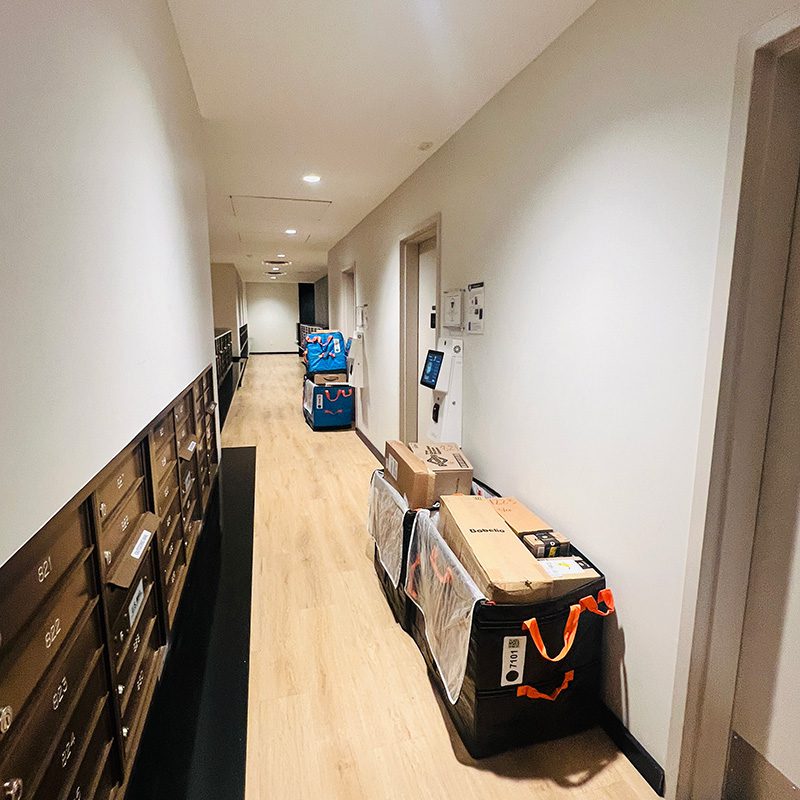
Parcel volume puts a number on the constraint. The Pitney Bowes Parcel Shipping Index identified US parcel volume at 23.1 billion shipments in 2025, equal to 171 parcels per household per year. A 300-unit property absorbs roughly 51,300 parcels a year, about 140 a day, and they all arrive through the same door that residents use.
Peak weeks push that past 200 a day. The December delivery run and move-in weeks land in the same lobby, on the same desk, in front of the same elevator bank.
The three additional constraints multiply the effect of increased package volume. Travel time makes each handoff longer, the single lobby routes every parcel question to one person, and volume sets how often that happens. A staffing model built on unit count captures none of it, which is why high-rises are the property type the ratio understates most.
The Largest Removable Task on the Schedule
Most administrative work can’t be removed because it requires personal judgment. A lease exception, a delinquency conversation, a neighbor dispute: those belong to a person.
Package handling doesn’t. It’s high frequency, entirely process-driven, and it requires no judgment at any step, which makes it the largest single opportunity in on-site staff efficiency in multifamily.
Walk the sequence and total the minutes. A parcel arrives and gets scanned and logged. A staff member shelves it. A resident asks where it is. Staff search for the package, then hand it over. Then there are the exception cases, the lost parcel, which runs fifteen minutes or more once the search, the reply, and the follow-up are counted. For example, if routine parcels move in about two minutes, an eight percent exception rate pulls the blended average above three.
Use your own numbers to properly gauge the impact on your building. Count handling events and minutes for one week, then apply a loaded hourly rate.
Now consider the alternative with an automated solution like the Smart Package Room® system. Couriers and staff scan packages at delivery with the MobileKiosk™ handheld scanner, then the Amoeba Module® precision tracking technology holds each parcel’s location on the standard shelf, and residents get an automatic text and email the moment it is delivered. This is how the task can be removed from the staff’s schedule.
The cost side is already moving against you. The National Apartment Association reports administrative and payroll expenses at $2,323 per unit in 2024, up 3.81 percent, while total income per unit grew just 1.5 percent. Test the labor line against your own volume with the Smart Package Room package management cost calculator.
Centralize, Automate, or Hire: Choosing the Right Lever
Three levers exist for improving on-site staff efficiency in multifamily, and each suits a different kind of task.
Centralization suits work that doesn’t require a physical presence. Lead response, application screening, renewal outreach, and accounts payable all run from a shared team covering several properties.
Automation suits work that requires no judgment. Package notifications, rent reminders, work order acknowledgments, and access provisioning follow the same steps every time.
Hiring suits work that requires both presence and judgment. A neighbor dispute, a difficult move-out inspection, and a tour with a hesitant prospect all need someone in the building who can read the situation as it develops.
Each lever fails in a predictable way. Centralization pushed too far strips out the local knowledge residents rely on, and the caller who explains their situation three times to three different people will become frustrated. Automation applied to judgment work drives escalations, since the system produces an outcome that no one can defend and a person has to unwind it. Hiring applied to a process problem raises the payroll cost of an inefficient system without fixing the system.
Systems architecture decides how much you can remove. Tasks that live across property management software, access control, and resident apps are easier to eliminate when those systems share a record. Be sure to check the standard integrations before you conclude that a task has to stay.
Then apply the test above. Identify the task, ask whether it needs a personal presence and/or whether it needs judgment, and let the two answers pick the lever.
The Line You Should Not Cross
Two facts from the same market pull in opposite directions. J Turner Research found that customer service appeared in 77.59 percent of all resident reviews in 2025, up year over year, while 63 percent of multifamily C-suite leaders named reducing operational costs as their biggest challenge.
Set those side by side and the primary constraint is obvious. Residents talk about people. Leadership is under pressure to spend less on people. On-site staff efficiency in multifamily gained by removing human contact shows up in the reviews, and reviews affect the next prospect who does research on your building.
Turnover raises the cost of getting this wrong. The National Apartment Association puts on-site turnover at 29.2 percent against 14.2 percent for corporate roles, and the mechanism compounds. A short-staffed team fields more complaints, complaints add complexity to the job, and the harder job leads to employee resignations.
The rule holds in its strongest form. Remove tasks so the team can do the work that residents rate highly. An efficiency plan that opens with a headcount number can raise complaint volume, and it will surface in the review score.
There’s a practical version of the test. Before approving any reduction, ask whether a resident would notice it. Nobody notices that parcels stopped being logged by hand, but all residents will notice when the staff member who knew their dog’s name is gone.
How to Measure On-Site Staff Efficiency in Multifamily
Four measures cover it. Hours logged by task category. Interruptions per staff member per day. Median time to close a work order. Resident review themes that identify changes.
The baseline is the hard part. Almost no property has task-level hour data, which is why efficiency work is so difficult to defend afterward. When asked whether the change worked, the honest answer is usually that no one measured it before.
Build the baseline with a one-week time study. Keep a tally sheet at the front desk with six or seven task categories on it. Have staff mark a notation each time they start one of the tasks. It’s imprecise and takes only a week, but it beats having no data at all. Repeat it the same week the following year so seasonality doesn’t distort the comparison.
State the financial case once and move on. Multifamily Executive reports leasing and administrative salaries at 21 to 25 percent of total operating expenses for mid-market operators, one of the largest controllable cost categories on the statement. With qualified baseline measurements, you’ll not only be equipped to control cost, you’ll begin maximizing NOI with every new investment.
Frequently Asked Questions About On-Site Staff Efficiency in Multifamily
1. How Do You Improve On-Site Staff Efficiency in Multifamily Properties?
Start with a firm measurement. Improving on-site staff efficiency in multifamily properties begins with finding where the staff hours go, since roughly two-thirds of the on-site week runs on administrative and reactive work. Sort every recurring task by two tests: whether it needs physical presence and whether it needs judgment. Those answers pick the lever, whether that’s centralizing, automating, or hiring. Hold one discipline throughout, which is that you’re removing tasks and not people.
2. How Many Units Should One Property Manager Handle?
One manager per 100 units is the figure in circulation, but that’s best viewed as a starting point to the conversation. Unit count doesn’t predict workload. Factors such as delivery volume, building height, amenity count, and resident profile move the real number substantially. Derive headcount from a week of counted tasks and hours instead, then use the ratio as a sanity check on the result. High-rise buildings are the property type that the ratio most understates because it doesn’t account for bottlenecks and vertical travel.
3. What Percentage of the On-Site Week Goes to Administrative Work?
The National Apartment Association puts routine administrative work at 42 percent of the on-site week, reactive work at 24 percent, and meaningful resident engagement at 17 percent. The reactive share is the one that most surprises operators, since almost none of it appears on a schedule anywhere. The administrative bucket is where the removable tasks live, which makes it the right starting point for any on-site staff efficiency in multifamily project.
4. Is Centralization Better Than On-Site Staffing?
Neither wins outright, so sort by the task instead. Centralization works for anything that doesn’t require physical presence, such as lead response or accounts payable. It fails for work that residents expect a person on site to handle, such as a neighbor dispute or a move-out walk. The risk that gets underestimated is the loss of local knowledge, which residents feel immediately. Pilot one task category before restructuring a portfolio.
5. Why Do High-Rise Properties Need Different Staffing Models?
Three constraints drive it: vertical travel time, a single lobby that concentrates every interruption, and delivery volume arriving through one door. They exacerbate the challenges, which is why on-site staff efficiency in multifamily properties can’t be planned from unit count. A 300-unit property takes in roughly 51,300 parcels a year, all through the entrance that residents use. This affects the amount of staffing required for coverage, since a property needs someone at the desk through delivery hours in a way a garden-style property doesn’t.
6. How Much Staff Time Does Package Handling Consume?
This is one metric that can be counted. Package handling arrives on-site as waves of interruptions, so without an automated solution its effect hides inside the day and rarely reaches any log. To understand its impact, tally handling events and minutes for one week, then apply a fully loaded hourly rate. Watch the exception cases closely. A missing parcel runs fifteen minutes or more once the search, the reply, and the follow-up are counted, and exceptions drive a disproportionate share of the total.
7. Does Technology Always Reduce Staff Workload?
It depends entirely on what the technology does to the task list. Technology reduces workload when it removes a task, and increases it when it adds a system that must be maintained. After any rollout, check whether a task was eliminated or whether the tool just added a new place to enter the same information. Shared records across the systems you already run matter more than any single tool when you’re weighing on-site staff efficiency in multifamily.
8. What Does On-Site Staff Turnover Cost a Property?
On-site turnover runs at 29.2 percent against 14.2 percent for corporate roles, per the National Apartment Association, and direct replacement cost is only part of the bill. The compounding part matters more. A short-staffed team fields more complaints, which makes the job harder, which leads to staff turnover. Turnover cost rarely appears in an efficiency calculation, even though it’s one of the largest consequences of getting that calculation wrong.
9. Can You Cut Payroll Without Hurting Resident Satisfaction?
It depends on which kind of payroll you cut. Payroll removed by eliminating repetitive tasks is invisible to residents. Payroll removed by eliminating the staff members that residents interact with is not, and J Turner Research found that customer service appeared in 77.59 percent of resident reviews in 2025. Before approving any reduction, identify which category the payroll cut falls into. If a resident is likely to notice the change, that may negatively affect resident satisfaction.
10. How Do You Measure Whether Staff Efficiency Improved?
Four measures: hours logged by task category, interruptions per staff member per day, median time to close a work order, and resident review themes. First, establish a baseline so you can understand task-level hour data before a recommended change. Run a one-week time study with a simple tally sheet. Then repeat it the same week a year later to measure the improvement. Skip headcount per unit, because it only records spending and tells you nothing about on-site staff efficiency in multifamily.
Key Takeaways
On-site staff efficiency in multifamily is a nuanced task problem that’s representative of more than headcount, and in a high-rise those tasks cost more than the same tasks anywhere else. Once you can see where the week goes, the decisions get easier, because most of what’s crowding the schedule turns out to be work that doesn’t need a person at all.
The fundamentals to remember:
- Find the hours first, because two-thirds of the on-site week is administrative and reactive work that isn’t initially scheduled.
- Sort by presence and judgment, to understand the right lever every time.
- High-rise properties compound everything, as travel time, one lobby, and concentrated delivery volume multiply rather than add.
- Parcels are the biggest removable task, high in frequency and requiring minimal judgment.
- Never reduce resident contact, because efficiency taken out of resident interaction returns as complaints.
Run the one-week tally first. Then bring us the counts, your unit mix, and the number of parcels that come through your lobby, and we’ll work out which tasks can leave the schedule and what that returns to leasing and resident engagement. It’s a faster route to better on-site staff efficiency in multifamily than another payroll conversation. Contact our team today.