


Since 2021, repairs and maintenance costs at multifamily apartment properties have climbed nearly 28 percent, while net operating income has grown just 10 percent. Rent growth alone can’t close that gap in today’s softer leasing market, so the levers that remain represent the controllable lines in your operating statement. Package handling is one of those items, and owners rarely see it priced. If you’re underwriting a multifamily package delivery solution as a capital item, the return on that investment will show up in two places.
Increasing NOI via package automation means moving net operating income, a property’s income less its operating expenses before debt service, through parcel handling costs and renewals. This article works the numbers through a 300-unit property to a per-unit figure, then calculates what that figure is worth at exit, in terms of dollars of asset value. The wider expense picture (covered in reduce operating expenses at multifamily buildings) is what makes a small per-unit saving worth modeling at all.
The Two Places Package Automation Shows Up in NOI
The formula is short. Net operating income is total income minus operating expenses, measured before debt service. Package operations touch both halves of it, and increasing NOI via package automation depends on counting both.
The expense side has two levers. The first is labor, since every parcel your team receives, shelves, looks up, and hands over costs minutes of a paid hour. The second is disputes: the goodwill replacements and staff time that follow a missing parcel.
The income side of the equation gets less attention. Renewals prevent turnover cost and the vacancy loss that comes with it. Where local rules and your lease permit, an amenity or package fee can also provide additional income and increase resident satisfaction. Neither line appears in a pure labor analysis, which is why most published NOI arguments stop at payroll.
Both line items are larger than they look. The National Apartment Association reported in From Momentum to Management, by Erioreoluwa Bajomo, that other income rose 5.4 percent to $1,482 per unit. Vacancy and rent loss rose to $1,323 per unit, its fourth consecutive annual increase. On line items this size, a few hundred dollars per unit constitutes a meaningful share, which is why increasing NOI via package automation is worth modeling line by line.
A 300-Unit Worked Example
The example below builds each line from a published figure or a stated assumption. Swap in your own inputs as you go, and the structure still holds.
Parcel Volume: Sizing the Workload
Start with volume, the most important input in the equation. The Pitney Bowes Parcel Shipping Index reports that US parcel volume reached 23.1 billion shipments in 2025, equal to 171 parcels per household per year. At that rate, a 300-unit property receives roughly 51,300 parcels annually, or about 141 a day.
That daily average understates the high-volume shipping weeks that occur every year. Amazon Prime Day, Cyber Monday and the holiday shopping season, and move-in periods push package volume several times higher than a typical week. Those are the weeks that generate staff overtime and lost parcels. Check the derived figure against one week of counting before it goes into a model, since a counted number holds up better with an investment or approval committee.
Handling is the next data point to consider. Manual handling runs a blended three minutes per parcel: about two for a routine parcel, and fifteen or more for the roughly 8 percent that become exceptions. At 51,300 parcels, that’s 2,565 staff hours a year, about seven hours every day. Those hours are the raw material for increasing NOI via package automation.
The Expense Line: Hours, Disputes, and Replacements
Price those hours at a loaded rate, using a $23.97 leasing wage, since leasing staff absorbs most parcel work at properties without a concierge. Benefits run 30.1 percent of total employer cost in the BLS Employer Costs for Employee Compensation release for March 2026, so divide by 0.699 to reach $34.29 an hour. That’s $87,954 a year in parcel labor; test it against your building with the package management cost calculator.
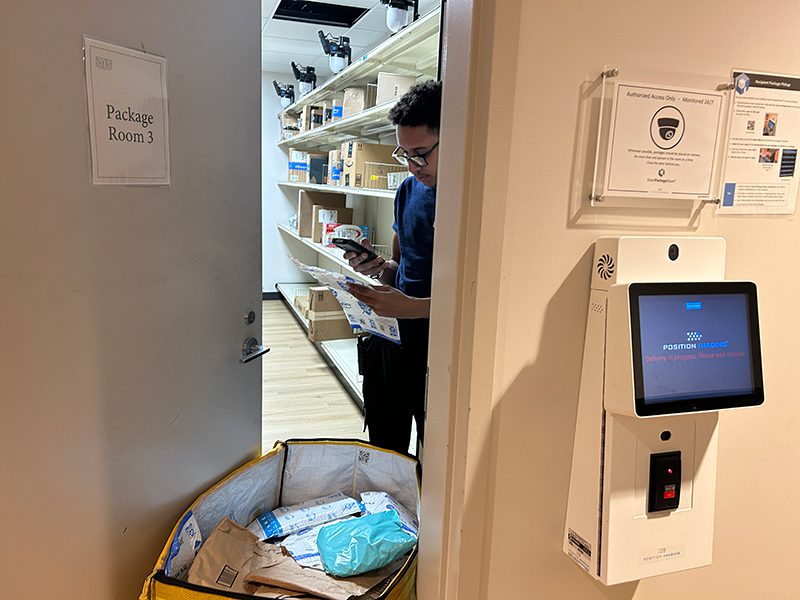
With Smart Package Room®, couriers and staff log parcels at delivery with the MobileKiosk™ handheld scanner, and residents pick up packages on their own using a QR code delivered to their phone. With delivery and pickup automated, staff time spent on packages drops to about one minute per parcel. Harbor Pointe Apartments reports seven daily staff hours saved at 200-plus packages a day. Annual labor costs fall to $29,318, cutting $58,636, the largest line item in increasing NOI via package automation.
Assume 24 goodwill package replacements a year at Security.org’s average stolen package value of $222. If replacements fall to four, the savings are $4,440.
One condition governs this whole line. Labor savings reach NOI only when payroll changes, a vacancy is not backfilled, overtime is cut, or a coverage contract is reduced. Hours redeployed to leasing show up on the income side, so don’t count them twice.
The Income Line: Renewals and Other Income
The income side is an estimate, and the model should say so. Multifamily Executive reported in their article Why 2026 Will Be the Year Operational Performance Defines Multifamily Success, by Arthur Attal, that resident turnover costs $3,500 to $5,000 per unit. That range accounts for vacancy loss, marketing, make-ready work, and leasing commissions. The same piece puts leasing and administrative salaries at 21 to 25 percent of total operating expenses for mid-market operators.
Apply a small change in retention. Half a percentage point on 300 units is 1.5 fewer move-outs a year, resulting in $5,250 at the low end of the turnover range. One full point at the high end results in $15,000. The base case uses the low figure, labeled as an estimate, because increasing NOI via package automation should rest on the expense line.
Other income stays at zero. A package or amenity fee belongs in a separate scenario, since local rules vary. Then subtract recurring costs. The illustrative system in this example carries $5,000 a year in operating fees, which sit inside NOI.
| Line item (300 units) | Annual NOI effect | Type |
|---|---|---|
| Parcel labor saved (1,710 hours × $34.29) | +$58,636 | Measured |
| Goodwill replacements avoided (20 × $222) | +$4,440 | Counted from records |
| Recurring system fees (illustrative) | −$5,000 | From your proposal |
| Measured NOI change | +$58,076 | Subtotal |
| Retention (0.5 point × 300 units × $3,500) | +$5,250 | Estimate |
| Package or amenity fee | $0 | Excluded from base case |
| Total NOI change, base case | +$63,326 | Total |
| Per unit | +$211 | Total ÷ 300 |
Assumptions behind every line:
- Volume: 300 units × 171 parcels per household (Pitney Bowes, 2025) = 51,300 parcels a year.
- Handling: 3.0 blended minutes per parcel manually (2.0 routine, 15+ for about 8% exceptions); 1.0 minute with automation.
- Labor rate: $23.97 leasing wage ÷ 0.699 = $34.29 loaded (BLS ECEC, March 2026).
- Disputes: 24 goodwill replacements a year falling to 4, at $222 each (Security.org).
- Retention: +0.5 point at $3,500 per turnover (low end, Multifamily Executive); high case +1.0 point at $5,000 = $15,000.
- System cost: $5,000 a year in recurring fees is not a quote. Installed cost is treated as capital, below the NOI line. Confirm with your accounting policy.
- Labor savings count toward NOI only when payroll changes.
What Increasing NOI via Package Automation Is Worth at Exit
A property’s asset value is its net operating income divided by the capitalization rate. A permanent change in operating income therefore changes the value by a multiple of itself, and that multiple is one divided by the cap rate. At a 5 percent cap rate, every permanent dollar of NOI is worth $20 at exit.
Work the example through. The base case adds $63,326 a year, or $211 per unit across 300 units. Divide by two cap rates to see the range:
- At a 5.0 percent cap rate: $63,326 ÷ 0.050 = about $1.27 million in added value.
- At a 6.0 percent cap rate: $63,326 ÷ 0.060 = about $1.06 million in added value.
Strip out the retention estimate and the measured lines alone, $58,076, still support about $1.16 million at 5 percent and $968,000 at 6 percent. Lead with that number in front of a buyer’s underwriter, since it’s the part of increasing NOI via package automation that they can verify. The cap rate is your variable, so use the one your asset management team applies to this property.
Market conditions add relevance to the exercise. CBRE Research expects multifamily cap rates to remain stable in 2026, with incremental compression thereafter, in its US Real Estate Market Outlook 2026. Overall multifamily vacancy is 4.4 percent, against a 2010 to 2019 average of 5.2 percent. Stable rates mean that a invested gain that’s built now is valued on today’s terms.
The Lease Retention Argument, Stated Carefully
Lease retention carries more weight than it used to. CBRE reports that lease renewals now account for 57 percent of all leasing activity, up from 51 percent in 2015 and 48 percent in 2005. Lease renewals avoid turnover costs, and they outpace new leases in rent growth. A property that keeps more residents earns on both lines, which is the income half of increasing NOI via package automation.
Attribution is tough to nail down because properties can’t prove that a renewal happened because of specific amenities such as the package room. Residents renew for location, price, convenience, maintenance response, and a dozen other smaller factors. Parcel delivery is just one of them. It’s a near-daily one, but it’s still only one contributor among several.
With this in mind, model it conservatively. Use a small retention change, show it as a range, and label it as an estimate everywhere it appears. In the worked example, that’s half a point to one full point, or $5,250 to $15,000 a year.
Invest in the time to understand it. An owner discounts any number they can’t verify, and an inflated input has the potential to drag the rest of the model down with it. At a 5 percent cap rate, the high case adds about $195,000 in value over the low case. That’s enough to mention and too uncertain to lead with, which is why increasing NOI via package automation should open with the expense line.
What This Model Does Not Capture
Several costs sit outside the model. The first is implementation. Installed equipment usually falls below the NOI line as a capital item, depending on your accounting policy. In this way, it affects your return on investment but not NOI itself. Don’t only compare that capital cost against the value created at exit. Weigh it against one year of savings.
The second cost that sits outside of the model is disruption during installation. The third is space, since a room that displaces a rentable or amenity area produces a tangible opportunity cost.
Softer items can’t be verified at all. Review scores, prospect impressions on tour, and staff retention may all move, and none of them belongs in a model an owner will audit.
Sensitivity is concentrated in two inputs. If manual handling runs two minutes per parcel instead of three, the labor-saving halves to $29,318 and in the base case NOI change falls to about $34,000. Second is the retention assumption. Be sure to test those two inputs before the model goes to review.
The reasonable position is that this model is a floor, not a forecast. It’s most useful when every assumption is visible to whoever reviews it, because increasing NOI via package automation is a claim an owner should be able to check line by line.
Frequently Asked Questions About Increasing NOI via Package Automation
1. How Does Increasing NOI via Package Automation Work?
Increasing NOI via package automation works on both sides of the equation. It removes parcel handling hours and dispute costs from expenses, while it supports renewals, plus other income at some properties, on the revenue side. The expense side is measurable with a week of timing and your payroll records. The income side is an estimate and should be labeled that way. The 300-unit worked example above shows both, with every assumption printed under the table.
2. What Is Net Operating Income in Multifamily?
Net operating income is a property’s income minus its operating expenses, before debt service and capital items. Owners use it because it isolates how a building performs from how it’s financed, so two properties with different loans can be compared directly. The two exclusions people most often get wrong are debt service and capital expenditure. Leave both out, since including them mixes financing and one-time spending into a measure of operations.
3. How Much Does a Small NOI Gain Change Property Value?
Value is net operating income divided by the cap rate, so a permanent annual gain is worth a multiple of itself at exit. The multiple is one divided by the cap rate. A $10,000 permanent gain at a 5 percent cap rate adds about $200,000 in value. That’s the core arithmetic behind increasing NOI via package automation. The gain must be permanent and documented to survive an appraiser or a buyer’s underwriting, so a one-time saving doesn’t count.
4. Can Package Management Generate Ancillary Income?
Some properties recover part of the cost through an amenity or package fee, and other income has been rising, reaching $1,482 per unit in the National Apartment Association’s 2024 figures. There are limits, however. Local rules on fees vary by jurisdiction, and a fee attached to a process that residents already find frustrating will likely generate complaints. Fix the process first, then decide whether to charge for it.
5. How Do You Calculate the Labor Cost of Package Handling?
Multiply annual parcel volume by measured handling minutes, divide by 60, and multiply by a fully loaded hourly rate. The loaded rate is the input that people generally underestimate. Benefits ran 30.1 percent of total employer cost in the BLS March 2026 release, so divide the wage by 0.699, which adds roughly 43 percent. Count exception handling too, since a missing parcel takes longer to locate and deal with than a routine one. This labor line is the measurable half of increasing NOI via package automation.
6. Does Package Automation Affect Resident Retention?
Delivery experience is one contributor to a renewal decision among several, and no property can isolate its share. It still belongs in a model. CBRE reports that renewals now account for 57 percent of all leasing activity, and turnover costs $3,500 to $5,000 per unit. A small retention change across a full rent roll adds up quickly. Use a conservative assumption, show it as a range, and label it as an estimate.
7. What Cap Rate Should You Use in the Calculation?
The right rate depends on your market, the asset class, and the building’s vintage. Your asset management team will have the figure it uses. Show the result at two rates, so the sensitivity is visible to whoever reviews it. CBRE expects multifamily cap rates to remain stable in 2026, with incremental compression thereafter. When increasing NOI via package automation, treat the cap rate as the owner’s variable, not the vendor’s.
8. Is Package Automation a Capital Improvement?
Classification depends on the owner’s accounting policy and on how the purchase is structured, so confirm it with your asset management team. The practical point matters more. How an investment is classified determines which budget the request goes into and who approves it. This could factor heavily into whether it is approved, however strong the math is. A request that stalls in one budget can be shifted to another, so look into which one has flexibility first.
9. How Long Before the NOI Improvement Shows Up?
Expense and income benefits show up on different timelines. Expense savings appear within a quarter of the process change, provided payroll changes with it, since the hours stop being spent right away. The income side takes a full lease cycle, because renewal decisions form months before a lease ends. Report the two separately so the early result isn’t overstated, then revisit the retention estimate after twelve months of data.
10. What Is the Most Common Mistake in This Calculation?
The most common mistake in increasing NOI via package automation is presenting the retention estimate with the same confidence as the measured labor saving. Owners discount the whole model when one input looks optimistic. Separate measured figures from estimates in the presentation itself and print every assumption. The second common error is using a base wage, not a loaded rate, which understates the labor line by about 30 percent.
The Bottom Line
Package operations can be so much more than a simple amenity. They can be an expense line item with a valuation consequence. Measure the hours, price them at a loaded rate, and divide the permanent gain by your cap rate. When the numbers make sense, increasing NOI via package automation becomes a figure that a decision maker can underwrite.
The fundamentals to remember:
- Both sides of the equation, because parcel handling touches expenses and renewals.
- Divide by the cap rate, since a permanent operating gain is worth a multiple of itself at exit.
- Show every assumption, as a model an owner can audit survives review, and a model they can’t will be ignored.
- Separate measured from estimated, because a single optimistic input discredits the whole calculation.
- Model conservatively, given that a modest defensible number is more persuasive than a large one that can’t be trusted.
Bring three numbers: your unit count, your current parcel handling hours, and the cap rate your asset management team uses. We’ll build the per-unit figure with you and show what increasing NOI via package automation is worth for your property at exit. Book a demo to start with your own model.