


You tightened overall access control into your building last year, yet the deliveries worsened. Drivers would still leave parcels in the vestibule, buzz random units until someone lets them in, or skip the stop and mark it undeliverable, resulting in another package delivery-related resident complaint. That’s the core tension at the center of courier access control for high-rise mailrooms. Every new control that you add is another reason a delivery driver doesn’t complete the drop-off successfully.
The good news is there’s a way out. It requires scoping credentials tightly enough to be safe and making the route fast enough that discourages couriers from propping a door open. A multifamily package delivery solution gives couriers one credentialed door and one destination, which is what keeps entry fast and auditable at the same time.
This article covers how each carrier gets into your building today, what breaks when the official process runs slower than the workaround, what a tower changes about all of it, and what to build instead.
Luxury apartment concierge vs automated package rooms, the staffing decision underneath every access policy, changes what a credential has to do and who has to be standing there when it’s used.
How Couriers Get Into Your Building Today
Before you design a policy, find out what’s already happening at your door. Four channels account for nearly every delivery entry in a tower, and the property controls fewer of them than most operators assume.
USPS: The Arrow Key and What It Opens
The Postal Service uses a standardized lock called an Arrow Lock. Buildings that accept it get a fixed cylinder on the entrance door, and every letter carrier on the route carries the matching arrow key.
The arrow key only works at the building entrance and the mail receptacle area. It doesn’t open individual units, and in most buildings it doesn’t open a secured package room.
What matters operationally is what you can’t do with it. Since you didn’t issue this credential, you can’t rotate it or see when it was used. There’s no log on your side at all. A property that audits every other door in the building has one entrance credential sitting outside its own system.
That isn’t an argument against accepting an Arrow Lock, since mail delivery will happen regardless. It’s an argument for keeping the package room on an access credential that you do control, so the door the Postal Service opens and the door your parcels sit behind are different.
Amazon: Driver Apps and Property-Granted Access
Amazon offers properties a program that lets drivers open the entrance through the delivery app. When the property opts in, Amazon supplies the hardware, and entry is tied to an active delivery. It’s important to note that it’s not tied to a person.
That delivery-bound design is genuinely good. A credential that works only when a driver has a parcel for your address is scoped more tightly than a fob sitting in a glovebox for months on end.
The trade-off is visibility. You’ve granted entry to a roster that you don’t maintain and can’t inspect. When a driver leaves the route, nothing changes on your side, because the credential was never issued to them individually.
Amazon is also the channel that you can least afford to slow down. The Pitney Bowes Parcel Shipping Index reports Amazon Logistics as the largest US parcel delivery provider by volume, at 6.9 billion parcels. Whatever you build must work for that channel.
UPS and FedEx: Fobs, Codes, and the Front Desk
These two usually run on credentials that your team issues. Ultimately, these couriers gain entry through a fob assigned to the route, a code on the entrance keypad, or a call to the front desk on every single visit.
Each method carries a different risk of failure. Fobs get handed between drivers and rarely come back when a route changes. Entrance codes get shared, and most buildings don’t change them regularly. Front desk buzz-in works reliably, but it results in staff interruption for every delivery.
There’s a real advantage to this kind of courier, though. Full-time carriers run consistent routes with low turnover, so the same drivers come back year after year. Your team can build working relationships with them, and a driver who knows your building and your staff will follow the process more reliably.
Use that. It’s the one channel where fostering a relationship does part of the security work for you.
Gig and Regional Couriers: The Fastest-Growing Unknown
This is the classification of courier that your policy probably wasn’t written for. Gig and Flex drivers work variable schedules, use their own vehicles, and get paid on stops completed, so speed is their entire incentive structure. Route consistency doesn’t exist. The driver at your door today may never come back.
Regional and last-mile contractors add another layer, and they’re the fastest-growing part of the picture. The same Pitney Bowes index puts growth in the “other carriers” category at 127 percent, which is telling considering that the category barely registered five years ago.
Consider how this change should affect credential design. A high-rise mailroom system built around four major carriers that operate similar business models assumes a stable roster, and there isn’t one anymore.
Keep this foundational point in mind. The set of people requesting entry at your lobby is no longer three national carriers plus Amazon. It’s a churning tail, and a policy that depends on recognizing a standard uniform that stopped working some time ago.
Why Courier Access Control Fails in High-Rise Buildings
Walk any tower in the afternoon and you’ll find the same four workarounds. A wedge or a mat holding the vestibule door open. An entrance code that hasn’t rotated in years and is written inside a delivery bag. A fob given to a driver in 2024 that was never returned. A resident who buzzes in anyone holding a parcel who says the word delivery.
These aren’t issues of discipline and treating them that way is how properties continue to struggle with building entry control. Every one of them is a rational response to a slow process by someone measured in stops per hour. A flex courier who loses ninety seconds at your door on forty stops a day loses an hour of paid work. They will find the faster path. So will your staff, and so will your residents.
The tower version is more challenging than the garden-style version for one structural reason. A high-rise concentrates every delivery through one lobby, so a single propped door exposes the entire building, including the elevator bank that reaches every floor.
That’s the key access control challenge. A true access control procedure that is slower than the workaround will be replaced by the workaround. Speed is what makes security hold.
Tailgating Is a Delivery Problem, Not a Security Abstraction
Tailgating is when a person enters on someone else’s credential by following them through the door. In the delivery context it’s rarely malicious on the courier’s part. Their hands are full, the door is heavy, and it’s not their responsibility to prevent people from entering your building, whatever their intentions are.
Delivery hours concentrate the exposure. Entry traffic clusters into predictable windows, mostly late morning and mid-afternoon, and so does the opportunity that comes with a door opening every few minutes. Anyone watching your lobby for a week will know those windows as well as your staff does.
The USPS Office of Inspector General recorded at least 58 million packages stolen in the United States in 2024 and names secure delivery locations as a primary mitigation. SafeWise puts the average value of a stolen package at $143, up 8.3 percent year over year, with Amazon parcels making up 32 percent of thefts, UPS 20 percent, USPS 18 percent, and FedEx 17 percent.
There are three countermeasures that cost a courier nothing. Door position sensors with propped-door alerts, so a wedged door alerts staff within a minute. A vestibule that separates the entry point from the residential core. And a package drop-off destination reachable without passing through the building at all, which proactively removes the problem.
Scoping Courier Access Control: One Door, One Window, One Destination
Strength and scope are different things. A stronger credential on a door that opens the whole building is worse than a simple one that opens a hallway for twenty minutes. Scope along three dimensions.
Scope by Door, Not by Building
Most access control systems default to a credential that exposes the entire building. When that’s the default, it’s a more costly problem than the type of door-specific credential system used.
A delivery-path credential opens only the doors on the route from the street to the package room. Vestibule, one interior door, package room, that’s it. The rest of the property remains secure, including the stairwell, the amenity floor, and the parking level.
The practical work here is mapping the path before you provision anything. Walk it yourself with a hand truck. Count the number of doors that a driver has to pass and cut every one that isn’t required, because all remaining doors represent a delay or a hole.
This is where Smart Package Room’s credential rules provide a more secure courier delivery path. Couriers and property staff use key cards or PINs. QR codes are for residents only, tied to a specific parcel, and they never get issued to a driver.
Done properly, a lost courier card can be easily managed and contained without leaving your property vulnerable to tailgaters.
Scope by Time Window
A credential that works at 3am on a Sunday is doing more than it needs to. Most buildings can narrow delivery access to a daily recurring window and cover 95 percent of arrivals.
Be honest about the trade-off, though, because this is where properties overtighten. A window that’s too narrow doesn’t stop deliveries outside it. It produces a driver at your door at 7:40pm with a parcel and no way in, which results in a vestibule drop, a buzzed unit, or a failed stop will result in a staff intervention at some point.
Set the delivery window from your own delivery data, which may differ from staff hours. Pull two weeks of arrival times, find the real first and last, then add a buffer on both ends.
Recurring windows suit the national carriers who serve you daily. One-time or short-lived access suits the gig and regional tail. Match the model to your learned carrier mix.
Scope by Destination, so the Route Ends at the Package Room
This is the dimension that allows you to create a path to success. If the credentialed route ends at a ground-floor package room, couriers never have a legitimate reason to reach a residential floor.
This point alone will reframe the hardest conversation in tower access control. Preventing access to elevators becomes a function of route design. Nobody has to argue about floor permissions when the destination is easily identified and thirty feet from the lobby.
It also removes the slowest part of a tower delivery. Vertical travel, waiting for the elevator, and walking door-to-door on a residential floor cost far more time than any credential check.
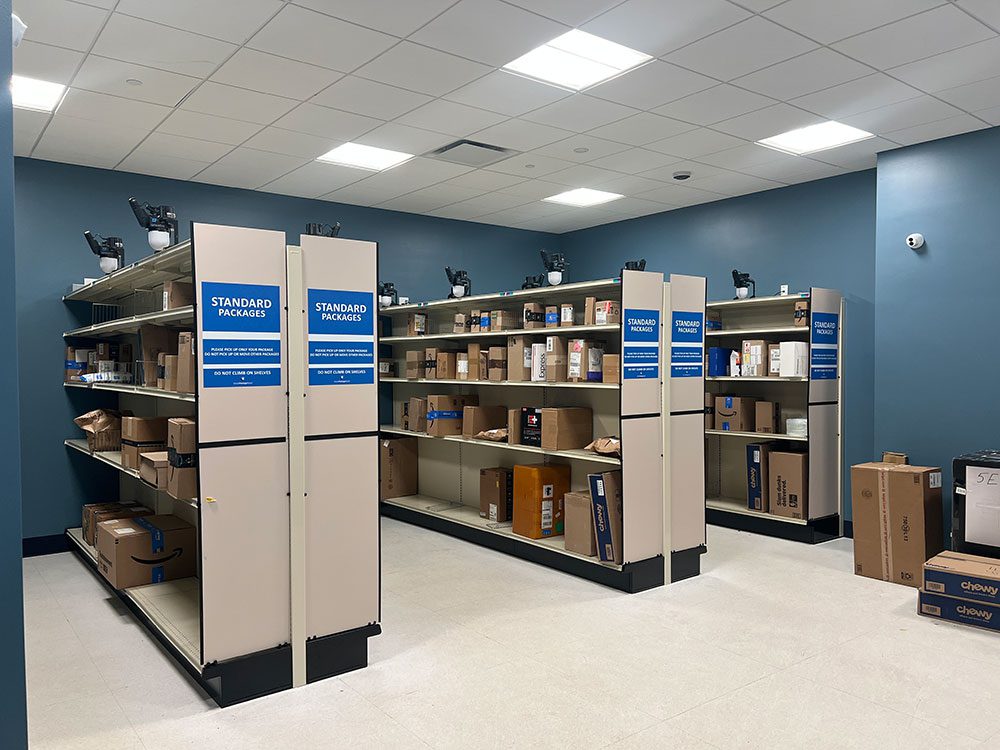
The destination must be set up to absorb the volume. This is where Smart Package Room’s secure open shelving system succeeds where scattered locker bays with fixed compartments can’t. Zones for standard, flat, oversized, cold storage, and dry-cleaning items mean a driver with a mixed load finishes at one stop. It significantly reduces the possibility of the kinds of misdelivered parcels that result in staff intervention.
Elevator and Floor Lockout in a Tower
A tower changes the geometry of the problem. One lobby, one elevator bank, and vertical travel time that a garden-style property doesn’t have. Residents, staff, and couriers all share the same elevators.
Two models exist. In the first, the courier reaches a ground-floor destination and never enters an elevator. In the second, the courier is granted a specific floor for a specific delivery, usually through an elevator control system that reads the credential and releases only that floor.
The second model is time consuming and costs more, in hardware, in provisioning time, and in every minute a driver spends waiting for the elevator. It also multiplies the number of credentials in circulation, since floor grants are per-delivery by design.
Confirm the constraints locally before you plan either one. Elevator recall and life safety release requirements vary, and controlled doors on an accessible route carry their own obligations. Your fire marshal and your elevator contractor settle this. It’s an important detail because getting it wrong is expensive to undo.
The throughput case favors the ground floor decisively. Removing elevator time from every delivery is the single largest speed gain available in a tower, and results in tighter access control for your property.
The Audit Trail: Turning Entry Into Evidence
A useful record answers five questions: who entered, through which door, at what time, what they were carrying, and where the parcels ended up. Most access systems only answer the first three.
That gap matters quite a bit. An access log registers that a door opened. A digital chain of custody records that a specific parcel arrived, sat in a specific place, and was picked up by a specific person at a specific time. When a resident says that a package never arrived, the system’s back-end portal illuminates what really occurred.
Here’s how the pieces align in practice with Smart Package Room. Couriers and staff scan packages at delivery with the MobileKiosk™ handheld scanner. Amoeba Module® precision tracking logs the parcel’s exact position on the standard shelf. Presence sensors monitor the room 24/7. The entry record and the parcel record then reconcile against each other, and the supported integrations carry that into your property management platform so they can be reviewed at any time.
This is the direction that the multifamily industry is moving in. The Security Industry Association’s 2026 Security Megatrends names security solutions losing their boundaries and the unification of the security experience layer as defining trends. A property that buys three systems that don’t talk to each other is bound to experience issues.
What Courier Access Control Costs Your Team in Hours
When you walk through the manual version, the cost becomes obvious. The buzzer sounds. Your leasing associate stops mid-sentence with a prospect, looks at the camera feed, analyzes who is there, releases the door, and then continues on to a conversation that has lost its momentum.
Here is a quick metric to shed light on the cost: buzz-ins per day, times minutes per interruption, times a fully loaded hourly rate. Log it for one week and you’ll have a defensible figure to reference in a budget conversation.
The part most counts miss is the recovery time. Releasing a door takes fifteen seconds. Getting back to where you were takes several minutes, and it happens on the same staff hours that your team needs for residents. That’s why this cost hides so well, it never appears as a block of time anywhere.
Market conditions raise the stakes on those hours. The US Census Bureau put national rental vacancy at 7.3 percent in the second quarter of 2026. In a soft market, the delivery experience is one of the few things a building fully controls, and it runs on the same staff hours the buzzer keeps interrupting. Plus, with the increase in daily deliveries, it represents an almost-daily resident touchpoint.
That’s the argument to bring to a budget conversation. A cohesive, secure access control solution means that the hours aren’t just saved, they’re returned to leasing and resident engagement activities.
Retrofitting an Older Tower Without Rewiring It
Older towers usually require less effort than operators expect. Entrance and vestibule doors often already carry controlled hardware, so the work is in provisioning and establishing rules. What changes more often is the package room door itself, plus network drops and power at the room.
A site survey goes a long way to settle this. Riser access, door frame condition, and existing panel capacity vary too much between 1970s and 2000s construction for any general rule to be effective.
Sequence the work so the building keeps running. Bring the delivery path up first, from the street to the package room, because that’s where propped doors lead to complaints today. Touch the residential core second, when the delivery path is stable and your team has stopped fielding daily entry questions.
Whether you’re retrofitting an existing space or designing a solution for a new development, the Smart Package Room design team can create a space specifically suited to your property. Installation typically takes one to three days once the room is built. Budget time for the training too, since thorough training is provided to all staff across on-site visits, phone or video follow-ups, and a training webpage. Teams that skip the training step will be slow to adopt the system and ultimately invent inefficient workarounds.
A Courier Access Policy That You Can Enforce
A policy that isn’t followed will result in porous access control. Six elements make it enforceable, and they should be followed by all teams.
Who is credentialed, by carrier and by name where possible. What each credential opens, stated as a list of doors rather than a zone name. How long it lasts, with an expiration date on every issuance. How it gets revoked, and by whom. What gets logged. Who reviews the log, and how often.
Then test it out thoroughly. Walk the policy yourself with a hand truck and time it against the workaround that it’s meant to replace. If following the rules is slower than propping the door, the rules will lose out, and no amount of signage will change the human behavior.
Revocation is one step that many properties skip, and it’s the quietest exposure you own. Driver turnover runs constantly across every channel, and a key card issued to a courier who left the route eighteen months ago will still provide access to your building unless it’s managed.
Review the credential list against the current carrier list quarterly. Give it to whoever administers the access system, usually the property manager or assistant manager, and have them sign off on the review. A named owner and a date will solidify access control.
Frequently Asked Questions About Courier Access Control
1. What Is Courier Access Control for High-Rise Mailrooms?
Courier access control for high-rise mailrooms is the set of credentials, doors, time windows, and logs that determine how a delivery driver enters a tower and reaches the package room. It differs from general building access control, which governs residents and their guests over long periods.
This one has to satisfy two goals that pull against each other. It needs to be tight enough to keep entry accountable and fast enough that drivers don’t route around it.
2. How Do Delivery Drivers Get Into Apartment Buildings?
Four ways, mostly. Postal carriers use a standardized key issued by the Postal Service. Amazon drivers use property-granted app access at buildings that have enabled it. UPS, FedEx, and regional carriers rely on property-issued fobs, entrance codes, or the front desk.
The fourth way is the one that operators underestimate: a large share of drivers get in because a resident holds the door or answers the buzzer. That channel exists at every property, whatever the written policy says.
3. How Do Mail Carriers Get Into Locked Apartment Buildings?
Through an Arrow Lock, a standardized postal lock that buildings can accept on the entrance door. Every mail carrier on the route carries the matching key, which opens the entrance and the mail receptacle area.
It doesn’t open individual units, and in most buildings it doesn’t provide access into a secured package room. Operators should know this one specifically because it’s the single entry channel the property doesn’t issue, can’t rotate, and can’t log.
4. Does Access Control Slow Down Package Delivery?
That depends entirely on route design. Courier access control for high-rise mailrooms slows deliveries when the credentialed path is longer than the workaround, and speeds them up when the path ends at a ground-floor package room.
Elevator time is the largest single cost in a tower delivery, so removing it usually more than pays for a credential check at the door. Track measured stop time rather than policy language. The number tells you whether drivers are following the route or going around it.
5. What Is Tailgating and Why Does It Matter for Deliveries?
Tailgating is one person entering on another’s credential by following them through an open door. In deliveries it’s usually incidental: a courier with full hands holds the door, and whoever is behind them comes in too.
It matters because delivery traffic clusters into predictable hours, which concentrates the opportunity into the same window every day. Two fixes cost the driver nothing: door position sensors that alert on a propped door, and a package destination that doesn’t require entering the residential core.
6. Should Couriers Get Permanent Credentials or One-Time Access?
Match the model to your carrier mix rather than picking one. Recurring credentials scoped to a single door and a defined window suit the national carriers who serve your building daily and send the same drivers for years.
One-time access suits the gig and regional tail, where the driver may never return. Each has a cost. Recurring credentials demand revocation discipline, and one-time access adds issuance friction on every visit. Courier access control works when both models run side by side.
7. Can You Stop Couriers From Reaching Residential Floors?
Design the question away rather than answering it. Couriers reach residential floors when the delivery destination is on one, so a ground-floor package room removes the reason to grant floor access at all.
The alternative is elevator control that releases a specific floor per delivery, which works but costs hardware, provisioning time, and driver minutes. Either way, confirm life safety release and accessible route requirements with your fire marshal before you restrict anything.
8. What Should a Courier Access Log Record?
Five fields: the identity or credential used, the door, the timestamp, the direction of travel, and the parcels associated with that entry. The last field is the one most systems omit and the one that matters in a dispute.
An access log proves that a door was opened. A chain of custody proves that a specific parcel arrived, at what time, and who picked it up.
9. How Much Staff Time Does Manual Courier Entry Consume?
More than a stopwatch suggests, because manual courier access control consumes interruptions rather than blocks of time, which is exactly why it hides inside the day.
This is measurable, though. Count buzz-ins for one week, multiply by minutes per interruption, and apply a fully loaded hourly rate. Then add the part most counts miss: the recovery time after each interruption, when a staff member is finding their place again in a conversation or a task. That recovery usually costs more than the door release itself.
10. Do You Need a Package Room to Control Courier Access?
Credentials alone can control courier access, and plenty of buildings run exactly that way with reasonable results.
A dedicated delivery destination like Smart Package Room addresses this problem. When the credentialed route ends at a ground-floor package room, there’s no reason to grant deeper access, so the hardest questions in tower access control stop coming up. Without a destination, you’re managing entry into a building. With one, you’re managing entry into a room.
Putting It Together
The durable access control is the fast one. Any process slower than the workaround gets replaced by the workaround, which is why courier access control for high-rise mailrooms succeeds or fails on throughput rather than on credential strength. Design it for the driver’s clock and security will follow.
The fundamentals to remember:
- Speed is a security control, because any process slower than the workaround will be replaced by it.
- Scope beats strength, so a credential that opens one door for a window of time is safer than a stronger credential that opens the building.
- End the route on the ground floor, which removes elevator access from the conversation entirely.
- Log the parcel, not just the door, since an access record alone cannot resolve a delivery dispute.
- Revoke on a schedule, because driver turnover is constant and an unrevoked credential is the quietest exposure you own.
Bring your carrier mix, your lobby layout, and one question: where should the credentialed route end. We’ll map the delivery path against your building and show you what courier access control for high-rise mailrooms looks like when the fast option and the secure option are the same. Talk to a specialist to learn how to secure your building today.