
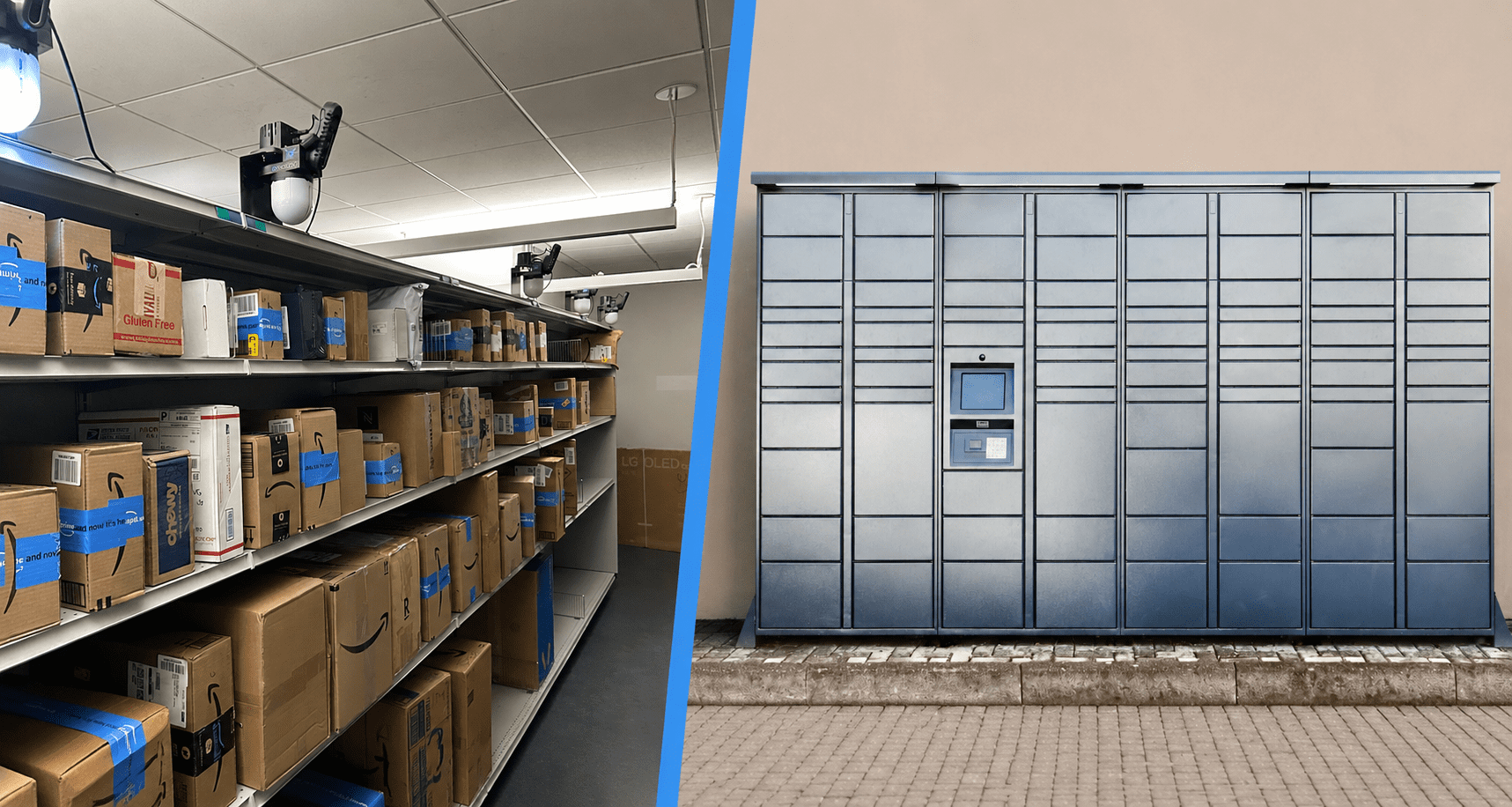

You’ve seen the packages piling up. You’ve crunched the numbers. You have an idea of what package management is costing your team in wasted hours, diverted staff attention, and frustrated residents. Now you’re ready to do something about it.
The question most property managers arrive at next is a practical one: Which solution should I invest in?
For most multifamily operators evaluating their options, online research and word-of-mouth recommendations typically lead to two choices: The Smart Package Room system and package lockers. Both are viewed as time-and-money-saving alternatives to the challenges of manual package management. However, they are not equivalent solutions. Understanding the differences between them is a critical step to take before committing capital and floor space to either one.
Here’s an honest, head-to-head look at how these two approaches compare across the dimensions that matter most to your operations, staff, and residents.
A Quick History: Why Lockers Made Sense, and Why That’s Changed
Package lockers were viewed as a breakthrough solution when they first entered the multifamily market more than 15 years ago. Before them, the primary options for managing packages were storing them on a designated shelf in the back office or converting a lobby counter to double as an unofficial staging area. Sorting was done manually by staff, and notifying residents was a cumbersome process. Lockers were well received because they offered a dedicated, secure, self-service delivery area that kept packages off the front desk and gave residents a structured way to retrieve their deliveries.
For a time, that was enough.
But the eCommerce landscape has transformed dramatically in the years since multifamily properties began installing lockers. Between 2019 and 2020, annual U.S. parcel volume grew nearly 40% to 20 billion packages. By 2028, that number is projected to reach 32 billion. Nearly half of all multifamily residents now receive three or more packages per week, which is a 20-percentage-point jump from pre-pandemic levels.
Additionally, the types and sizes of the packages themselves have changed. Residents are ordering more than just books and clothing. The convenience of eCommerce, combined with the speed and ease of shopping by smartphone, has broadened online shopping far beyond traditional retail to include groceries, meal kits, furniture, gym equipment, dry cleaning, and even prescription medications.
Lockers were designed for a shopping and shipping world that no longer exists. The question to weigh as you look at package management solutions is whether they can handle today’s – and more importantly, tomorrow’s – increased volume.
The Comparison: Six Ways They’re Not the Same

1. Space Efficiency and Installation Flexibility
A locker bank is a massive hardware system that requires substantial floor space at multifamily properties. Once a locker system is installed, its footprint is fixed. Without a costly addition or redesign, it cannot later be adapted to unusual room dimensions, changing property needs, or the seasonal fluctuations in volume that every multifamily property experiences. Further, because each compartment holds only one parcel regardless of its size, there is quite a bit of unused storage space. In more technical terms, the ratio of square footage consumed to packages stored is quite poor.
The Smart Package Room system’s open shelf, open zone design stores significantly more packages per square foot by eliminating the wasted space inherent to fixed compartments. The system consists of modular components, including shelving for standard packages, bins for flat packages, oversized zones for large packages, refrigeration units for cold storage items, and hanging racks for dry cleaning.
These modules can be configured to fit virtually any existing space, from purpose-built package rooms to converted garages, storage areas, or back offices. For new construction, the Smart Package Room in-house design team works directly with developers and architects to create customized floor plans that integrate the room into the property’s layout from the start. For renovations, the same flexibility allows properties to modernize without major construction.
2. Capacity and Package Volume
This is where locker limitations become most visible, and for many properties, most painful.
Lockers utilize fixed compartments that are sized small, medium, and large. In theory, that means a compartment for every package, right? Wrong. In practice, the pre-sized compartments create an inefficient use of space almost immediately. A single standard sized Amazon box can occupy a medium compartment with enough space to hold three or four standard packages. A resident who doesn’t pick up their delivery right away locks that compartment out of rotation. During ordinary weeks, these inefficiencies may be manageable. However, on Amazon Prime Day, Cyber Monday, or the holiday shipping window when your daily delivery volume may double, they’re not.
Couriers can’t slow down or fail to deliver, even if lockers hit capacity. They are likely to leave overflow packages on counters, in lobbies, and in hallways: exactly the problem lockers were installed to prevent.
The Smart Package Room system addresses this structurally. Its open shelf, open zone design accommodates up to three times as many packages in the same footprint as a comparable locker bank. Dedicated oversized areas and flat package bins absorb volume spikes without creating a mess. And because the system is modular, capacity can scale with your property’s growth rather than requiring you to purchase and dedicate space to an entirely new bank of hardware.
3. Package Type Acceptance
As resident shopping has evolved to include items like groceries, meal kits, dry cleaning, furniture, tires, workout equipment, and medicine, properties need to adapt how they receive, log, secure, and deliver these items to residents. Lockers, simply put, have nowhere to put these items.
Items requiring temperature control cannot be properly stored in a traditional locker bay. An add-on refrigerated locker module must be purchased to safely store groceries, meal kits, and medicine deliveries. Lockers cannot hang a dry-cleaning garment bag. And they don’t have the capacity to accommodate a mattress, flat-screen television, or indoor bike. When these deliveries arrive, couriers are left to improvise. Perishables may be left out in the open, at room temperature. Oversized items get stacked wherever there’s space. The result is a package management system that handles only a portion of what your residents receive.
The Smart Package Room solution is designed for 100% package acceptance. Standard packages go on open shelves that are tracked by AI-powered computer vision technology. Flat packages and envelopes are organized in labeled bins. Oversized items have a dedicated zone that accommodates large and irregularly shaped deliveries. Optional refrigerated areas handle perishables and cold storage deliveries. Optional dry-cleaning areas provide hanging space for garment bags and laundered items. Couriers always have a designated, secure location for every delivery type, without exception.
4. Security and Accountability
Lockers are access-controlled at the compartment level. A resident’s code opens their specific locker, and that’s the extent of the security architecture. This type of system is better than an unlocked lobby, but real gaps remain. Overflow packages left outside the locker bank are unmonitored. The audit trail is limited. If a package goes missing, there’s often little evidence to work with.
Smart Package Room secures the entire room, not just individual compartments. Access-controlled entry means only residents with a valid QR code or PIN can enter. Once inside, the Amoeba Module® uses precision tracking to monitor the location of every standard package in real time. Presence sensors track the movement of people and packages within the room 24/7. Resident access also stays current automatically through the system’s certified RealPage integration, which syncs unit and lease data without manual entry. Every delivery and pickup is logged in a digital chain of custody accessible through the management portal, giving your team the ability to perform audits, verify courier activity, and review footage when needed. When a resident says a package is missing, you have the data to find out exactly what happened.
5. Resident Experience
Residents are affected by package management more than most operators realize, because it’s one of the highest-frequency touchpoints in apartment living. A resident who shops online frequently interacts with your package system multiple times per week, every week of the year. A friction-filled pickup experience will not go unnoticed.
Locker systems typically require residents to sign up and download a proprietary app to access their deliveries. Despite this, when lockers are at capacity, residents may receive no notification at all and arrive at the locker bank to discover their package isn’t in the system. Retrieving multiple packages means separate transactions. For elderly residents who are not fluent in smartphone use, or for anyone unwilling to download yet another app, the system creates unnecessary barriers.
The Smart Package Room system requires no app. When a package is delivered, residents receive an automatic text or email containing a QR code and PIN. Scanning the code at the external kiosk displays a map of the room and a photo of the package’s location. Once inside, laser, light, and audio guidance directs residents precisely to their packages within seconds. Multiple packages can be retrieved in a single session without any additional steps. The room is accessible 24/7, and the entire pickup process takes less than 20 seconds from kiosk scan to package in hand.
No app, no waiting, no confusion.
6. Staff Burden
A foundational promise of any package management system is that it will reduce the time your staff spends managing deliveries. Lockers, however, no longer fully deliver on this promise.
One challenge is overflow. When lockers hit capacity—which is happening earlier in the day, and more frequently—packages are diverted to public areas that require staff management. Couriers rarely have the time, patience, or desire to work with staff on an overflow placement plan, so they dump the packages and move on to their next stop.
Compounding matters, residents who can’t navigate the app, can’t find their package, or have a delivery that doesn’t fit into the system are forced to come to the front desk to ask for help. The locker handles the routine deliveries, sure, but the overflow and exceptions still land on your team. And in package management, overflow and exceptions are common.
As outlined in Multifamily & Affordable Housing Business, manual package management at a 370-unit property consumes more than six hours of staff time per day. That figure doesn’t disappear with lockers. It may shrink, but the residual burden remains real. The Smart Package Room system, by contrast, significantly curtails staff involvement from the package delivery and pickup process. When delivering packages, couriers use the MobileKiosk™, a handheld device with Optical Character Recognition, to quickly capture package label data and deliver packages directly into the system. Residents are guided through self-serve pickup without front desk involvement. Your team is largely freed from both ends of the transaction, and those recovered hours return to leasing conversations, maintenance coordination, and resident engagement.
The Bottom Line: What You’re Actually Choosing Between
Evaluated on a single dimension, lockers and the Smart Package Room solution might seem like comparable options. Both are technology-forward. Both are more structured than manual management. Both offer some level of access control and resident notification.
But the comparison doesn’t hold up across the full range of what package management demands from a modern multifamily property. Lockers were engineered for a simpler delivery environment that consisted of mostly standard parcels, moderate volumes, and residents willing to download and navigate a proprietary app.
By contrast, the Smart Package Room system was built for the reality your property operates in today. One that features surging package volumes, diverse delivery types, security expectations, and residents that want a frictionless pickup experience.
“But We Already Have Lockers.” Addressing the Transition Question
If your property already has lockers installed, you might be saying: We’ve already invested in a solution, so why change now?
It’s a fair question, but consider the difference between sunk costs and ongoing costs. The relevant calculation is not how much you have already spent on lockers, it’s what they’re costing you now in unresolved overflow, staff involvement, resident friction, and package types that cannot be accommodated. If your lockers routinely hit capacity. If your staff still handles exceptions daily. If residents are contacting the front desk with package complaints. If you’re receiving deliveries like groceries, dry cleaning, and oversized items that simply don’t fit the system, then your lockers aren’t solving the problem.
The Smart Package Room system is designed to work within existing spaces, which means the transition is more straightforward than you might expect. And the financial case tends to be clear when you model it out. Use the Smart Package Room Cost & Labor Savings Calculator to input your property’s specifics — package volume, staff hourly rates, current pickup times — and see exactly what the numbers look like for your community.
Ready to See the Difference?
You’ve made the comparison. You’ve run the numbers. The question now is what the right solution looks like for your specific property, taking into account your volume, your space, your staff, and your residents.
Schedule a free demo and our team will walk you through a live look at the Smart Package Room system and a personalized estimate of what you can expect to recover in time, labor, and resident satisfaction.
Read more about the real cost of manual package management in our recent feature in Multifamily & Affordable Housing Business.
Ready to run the numbers for your property? Try the Smart Package Room Cost & Labor Savings Calculator →