


It’s Monday morning after a heavy delivery weekend, and you know what resident complaint is awaiting you: where is my package? It’s this complaint, multiplied by many residents, that has forced your leasing associate to spend two hours digging through boxes instead of running a tour.
The complaints aren’t a service failure, they’re the visible edge of a workload problem. And the teams that reduce property manager complaints start there. A multifamily package delivery solution, the open-shelf, open-zone system that absorbs peak delivery periods without adding staff, removes this kind of resident pain point outright.
This article covers which complaint categories are structural, which amenities remove them, which ones only look good on a tour, and how to tell the difference before you write a capital request. The same trade-off runs through the luxury apartment concierge vs automated package rooms decision, where the question is which tasks a human should own.
Why Are Property Manager Complaints a Staffing Number First?
Every resident complaint costs your team three blocks of time. Someone logs it, someone resolves it, and someone follows up to confirm it’s closed. The follow-up is the block that nobody schedules, and it’s the one that residents notice when it doesn’t happen.
Set that against the hours your team has. The National Apartment Association reports that on-site professionals spend 42 percent of the week on routine administrative work and another 24 percent reacting to disruptions, meaning that two-thirds of the week is committed before a single complaint arrives. Meaningful stakeholder engagement, which accounts for resident relationships and proactive outreach that defines onsite roles, accounts for just 17 percent of the average workweek.
Then it compounds. Complaint volume climbs when the team is short on hours. Every message pulled out of that 17 percent shrinks the window where a resident gets a real conversation, a cycle that fuels the next round of complaints.
Breaking the loop starts with a distinction that most complaint logs don’t make. Some complaints need human judgment: a noise dispute between neighbors, a billing question, a lease interpretation. Those belong to a person and always will. Others repeat identically every week, arrive through the same channel, and resolve the same way every time. Those belong to a process. Sorting your log into those two piles is what makes everything below actionable.
The Four Complaint Categories That Repeat Every Week
Most complaint logs sort by topic. For efficiency purposes, sort by repeatability instead, and four categories will account for the bulk of what your team fields. For each one, the question that matters is whether the cause needs a judgment or a process.
Maintenance Status: Where Is My Work Order?
The trigger is silence. A resident submits a work order, hears nothing for three days, and sends a follow-up asking whether anyone saw it. The repair itself may even be on the schedule. The complaint arises from a gap in communication.
Time it honestly the next time it happens. Someone reads the message, opens the work order system, finds the ticket, checks status with maintenance, and writes back. Six to ten minutes, and roughly half of that is the lookup rather than the answer. Multiply by your own weekly count, because that number varies more by property than any published benchmark would suggest.
The cause here is process. Nobody needs to weigh anything. A resident needs a status that already exists somewhere in your system. A support tool that pushes status automatically at submission, assignment, and completion removes this category without changing how maintenance works. That’s the test to apply to every fix below: does it change the work, or only the reporting?
Package Delivery: Where Is My Parcel?
This category scales with parcel volume, and multifamily parcel volume keeps climbing. The Pitney Bowes Parcel Shipping Index put US parcel volume at 23.1 billion shipments in 2025, up 3.3 percent year over year, equal to 171 parcels per household per year. Run that figure against a 250-unit building and you get roughly 42,750 parcels a year, about 820 a week.
Every one of those parcels is a potential message. The resident got a carrier notification saying their package was delivered, so they walked to the package room and didn’t find it. Now they’re asking you.
The resolution is a physical search. Staff or concierge walk to the room, check the shelves, check the oversized zone, check whether it went to the wrong building, then replies. They’ve spent ten to fifteen minutes on this mission, longer during a peak week.
The cause is process, entirely. No judgment is involved in knowing where a box is, which is exactly why this category is the most removable of the four.
Building Access: Who Let That Person In?
The trigger is usually a courier propping the front door while running a large delivery load in from the vehicle. A resident sees an unfamiliar person in the lobby and reports it. The complaint is legitimate, and the courier isn’t the villain here. Gig and Flex drivers are paid on speed, work variable schedules, and aren’t afforded the route consistency that would let them learn your building’s entry procedure.
Issue resolution is slow because the answer often doesn’t exist. Someone checks the access log, finds no credentialed entry matching that time, and has to reply that they can’t say who it was. Fifteen to twenty minutes later there’s still no resolution, which is what makes this category expensive.
The cause is part process, part judgment. Credentialing every courier at the package room door removes the delivery-related share of it. It won’t stop someone from tailgating through the lobby, so treat this as a category you shrink rather than one you eliminate.
Common Area Condition: The Lobby Looks Like a Warehouse
The trigger is overflowing parcels. Lockers fill by the middle of the week, so the rest of the week’s deliveries stack against the wall or are dropped off at the front desk. Residents complain about both the appearance and the security of parcels sitting in an open space. Then a prospect on a tour walks past the pile and files it away for when they’re deciding whether to sign a lease.
The resolution is manual and repetitive. Staff restack and move the overflow and oversized parcels to a back office, then field the questions that follow about where things went. The cost to your staff time is easily twenty to thirty minutes a day during peak weeks.
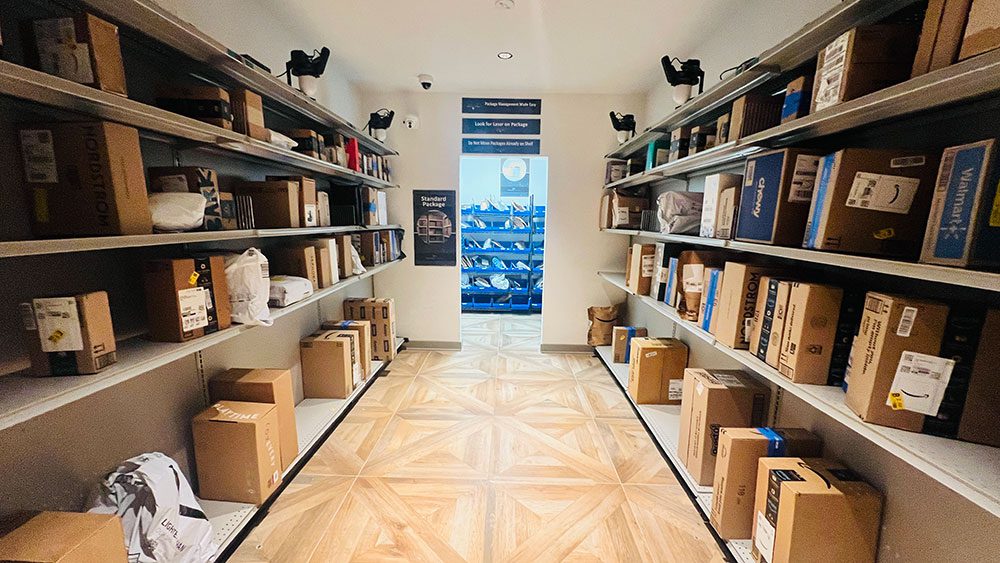
The cause is process, with a capacity problem underneath it. Fixed locker compartments hit a ceiling on the busiest day of the week, and everything past that ceiling lands on the floor or the front desk. Open shelving with dedicated zones for standard, flat, oversized, cold storage, and dry cleaning items holds 2-3x locker capacity in the same footprint, which will keep overflow from becoming a weekly lobby problem.
Which Smart Amenities Reduce Property Manager Complaints, and Which Do Not?
Start with the finding that complicates the amenity argument. J Turner Research analyzed resident reviews and found the term customer service appearing in 77.59 percent of them in 2025, against a 14.38 percent compliment rate for amenities. This makes sense because residents write about people, not the pool.
Any pitch that treats an amenity as a satisfaction driver on its own is arguing against that data. The useful distinction sits between two kinds of amenities.
A utility amenity removes a recurring task from the team’s week. Package handling, building access, and maintenance visibility all qualify, because each one takes work off a person’s desk and returns a faster answer than a person could give.
A lifestyle amenity adds an experience. The pool, the resident lounge, the rooftop deck. These win leases and photograph well on a tour, and they belong in the building. They don’t appear in the complaint log, so they don’t reduce property manager complaints.
The line between the two isn’t about how much a thing costs or how new the technology is. It’s about whether a task leaves someone’s desk when the amenity goes in.
That’s the argument the data supports for multifamily operators. The right amenities don’t make residents happy by existing. They free the hours that let your team have the interactions that residents rate you on. Buy the pool for the tour. Buy the utility amenity for the everyday touchpoint.
The Complaint Category that Nobody Counts
Walk a single package complaint from beginning to end. A resident messages the leasing inbox at 9:14 about a delivery that has arrived at the property. A staff member reads it at 9:40, then walks to the package room and checks the standard shelves, checks the oversized zone, comes back, checks to see if a neighbor picked it up by mistake, then replies to the resident at 10:02. Twelve minutes of staff time has elapsed, and forty-eight minutes of resident wait.
This category behaves differently from the other three. It’s high frequency, entirely process-driven, and it generates no goodwill when you resolve it correctly, because the resident expected the parcel to be there. You can only lose.
It’s a trend that’s not stopping as online shopping continues to grow. U.S. e-commerce sales reached $340.2 billion in the second quarter of 2026, 17.1 percent of all retail sales and up 6.7 percent year over year.
Removing this category of complaint is possible with a package management solution like Smart Package Room®. With it, couriers and staff enter a secure package room and scan packages at delivery with the MobileKiosk™ handheld scanner. Amoeba Module® precision tracking logs the exact shelf position of every standard parcel on the shelves. Residents get an automatic text and email notification with a QR code the moment the parcel is logged into the system, then Pick-to-Laser™ guidance directs them to it in seconds. It’s a simple process that all but eliminates the where-is-my-package message.
Run the math on your own building with the Smart Package Room package management cost calculator.
How to Tell Whether Complaints Are Falling
Four measures are worth the effort. Start with complaints per 100 units per month as a primary metric. Next, complaints by category tell you where the volume sits. Median time to resolution catches the follow-up gap. Staff hours logged against each category convert all of it into the currency that a capital request is written in.
Most properties can’t give you the first metric, complaints per 100 units per month, for last month. That’s a problem, and it’s why they’re unable to track overall progress. If they reduced that metric by fifteen messages per week but no one was keeping track, they won’t know which efforts to build on.
Start the count before you start shopping for solutions because a baseline gathered after a vendor conversation tends to reflect what the vendor asked you to look for.
This metric has real external ramifications. Unresolved complaints turn into negative public reviews, and SatisFacts Research found that 82.3 percent of residents read a community’s ratings and reviews before they ever make contact, with 63.3 percent expecting a response within two business days. Your complaint log and your review page are the same data at two different stages.
Give the measurement a defined window. Track one category for a full quarter before you change anything, then a full quarter after, and compare the two. A November-to-February comparison will tell you more about the holiday delivery surge than about your new system.
The Understaffing Loop and How to Break It
Here’s the loop in order. Short staffing slows response times. Slow responses generate complaints. Complaints consume staff hours that were already squeezed. This can lead to staff burnout, which perpetuates the cycle.
Staff turnover carries a steep price. The National Apartment Association put total turnover for on-site property-level employees at 29.2 percent against 14.2 percent for corporate roles, with the cost of replacing one rental housing employee close to $5,000. On-site roles turn over at more than double the corporate rate, in the kinds of jobs where residents form their opinion of your property.
The instinct when under budget pressure is to cut headcount. That runs the loop backward. A smaller staff means slower responses, which raises complaint volume, which is what made the hours short to begin with. Remove tasks, not people.
There’s a version of task removal that backfires. Automating a category that genuinely needs judgment moves the complaint rather than removing it, because the resident hits a dead end and is compelled to escalate to a person, leaving them angrier than when they started. Judgment categories stay with people.
That gives you a test to apply to any amenity proposal that crosses your desk. Does this remove a recurring task from the team’s week, and can the vendor tell you how many hours? A proposal that can’t answer the second half of that question is little more than a lifestyle amenity wearing an operations argument.
Frequently Asked Questions about Reducing Property Manager Complaints
1. How Do You Reduce Property Manager Complaints Without Adding Staff?
Start with removal, not speed. Reducing property manager complaints without adding staff means finding the categories that repeat identically every week and eliminating the process that generates them. Packages, building access, and maintenance status all qualify, because none of them requires judgment. A resident just needs information that already exists in a system somewhere. One caution, you can’t tell whether any of it worked without a per-category baseline recorded before the change.
2. What Are the Most Common Resident Complaints in Multifamily Properties?
Four categories carry most of the complaint volume: maintenance status, package delivery, building access, and common area condition. The ordering shifts by property type and delivery volume, and a high-volume building will usually see packages climb to first or second. Maintenance status is about communication more than repair speed. Building access spikes after heavy delivery days. Common area condition is often a symptom of a capacity ceiling somewhere else in the building rather than a housekeeping issue.
3. Do Smart Amenities Improve Resident Satisfaction?
Only when they remove a friction point that the resident feels weekly. J Turner Research found amenities drawing a 14.38 percent compliment rate in resident reviews against 63.11 percent for customer service, so an amenity that adds an experience without removing a task has little measurable effect. The ones that reduce property manager complaints work indirectly. They return hours to the on-site team, and those hours go into the resident interactions that reviews get written about.
4. How Many Complaints Should a 250-Unit Property Expect Each Month?
No neutral benchmark exists, so the best recommendation is to begin tracking immediately. Log every inbound complaint by category for 30 days and treat that as your baseline. What surprises most operators is the concentration of the complaint categories. Two or three categories usually account for the majority of the total, and one of them is almost always something nobody had been counting as a complaint at all. That first month of data is worth more than any industry figure.
5. Does Package Management Really Generate That Many Complaints?
Yes, and it’s tied to the increase in package deliveries. US parcel volume now runs 171 parcels per household per year and keeps climbing, which works out to roughly 42,750 parcels a year at a 250-unit property, about 820 a week. Even a small failure rate produces a steady stream of messages. The category stays invisible in most logs because these arrive as informal questions to the leasing inbox instead of formal tickets, so properties working to reduce property manager complaints routinely overlook their largest single source.
6. What Is the Difference Between a Utility Amenity and a Lifestyle Amenity?
A utility amenity removes a recurring task from the on-site team’s week. A lifestyle amenity adds an experience for the resident. Package handling, building access, and maintenance visibility are examples of utility amenities. The pool, the lounge, and the rooftop are examples of lifestyle amenities. A property needs both, and the lifestyle side does real work on a tour. The operational distinction is simple: a utility amenity changes what your team does day-to-day, and only that kind shows up in the complaint log.
7. How Do Complaints Affect Resident Retention and Renewals?
Three links connect them. Unresolved complaints become public reviews, reviews gate prospects before anyone contacts your office, and renewal decisions form months before a lease expires. SatisFacts Research found 82.3 percent of residents read a community’s reviews before making contact. No single complaint decides a single move-out, and claiming otherwise overstates the issue. What the pattern changes is the impression that a resident carries into the renewal conversation, which is why properties that reduce property manager complaints often see the effect in renewals first.
8. Can Technology Reduce Complaints If the Property Is Already Understaffed?
Yes, though the real question is whether a short-handed team can absorb a rollout, and that depends on what you automate. Categories that need no judgment can be removed without retraining anyone onto a new system. The Smart Package Room approach includes thorough training provided to all staff across on-site visits, phone follow-ups, and a video portal. Be realistic about the sequence though. A rollout costs your team hours before it returns them, so schedule it outside peak delivery season.
9. How Long Does It Take to See Complaint Volume Drop?
Plan on one full quarter at a minimum. Residents need time to change a habit, and seasonal delivery peaks will distort any comparison shorter than that. Compare the same quarter year over year rather than consecutive quarters, or the holiday surge will read as a failure. One thing that operators notice before the complaint count moves is the reclaimed hours. Staff feel the change in their week well before it shows up in a number, so properties working to reduce property manager complaints should track hours alongside counts.
10. What Should You Measure Before Installing a New Amenity?
Four numbers, recorded before anything changes. Complaint count by category for at least 30 days. Staff hours logged against each category. Your current review score, plus the themes inside the reviews rather than the number alone. Delivery volume, if packages are in scope. Without those four, no amenity can be evaluated after installation, and the spend becomes unaccountable by default. Collecting them takes a month, and it’s the cheapest part of the entire project.
Key Takeaways
Complaint volume is a workload figure as well as a satisfaction figure. Treating it that way changes which amenities can reduce property manager complaints and which ones belong in the building for other reasons.
The fundamentals to remember:
- Complaints are hours, so count them by category before you try to reduce them.
- Repeatable beats urgent, because the categories that repeat identically are the only ones a system can remove.
- Utility over lifestyle, since residents reward the amenities that quietly work far more than the ones that photograph well.
- Packages are the blind spot, and at current parcel volume they’re the largest uncounted complaint category in most buildings.
- Remove tasks, not people, because cutting the staff that residents interact with raises complaint volume rather than lowering it.
You already have the two numbers that this decision turns on: how many complaints land in each category, and how many parcels your building takes in every week. Walk both through with a specialist and see which categories a vision-tracked package room removes from your team’s week. To reduce property manager complaints starting with the largest uncounted one, contact our team.